 AlpacaKeep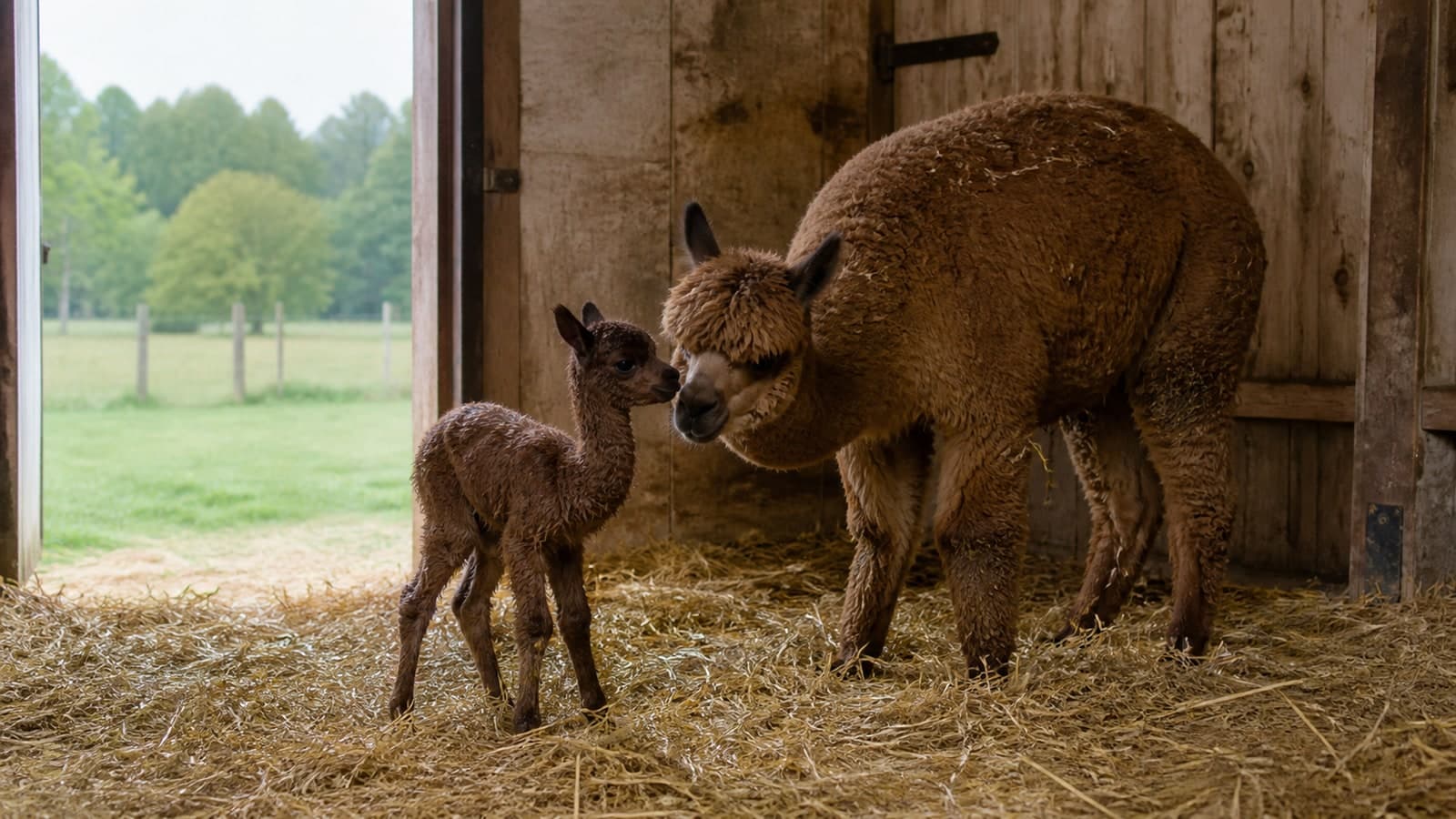
Most alpaca births go without incident. The published incidence of dystocia - birthing complications - is between 2% and 5%. But when something does go wrong, the dam can lose the cria, or both, in under an hour. Knowing the normal numbers in advance is the difference between a clean call and a panic.
South American camelids are unusual in two ways most other livestock species are not. First, the dam delivers standing in 65–73% of births - do not try to lay her down. Second, alpacas almost always give birth between mid-morning and mid-afternoon. A labor starting at 11pm is itself a flag worth a phone call to your vet.
Here are the stages, the numbers that matter, the malpresentations to recognize, and the exact thresholds that move the situation from "normal birth" to "call the vet now."
The Two-Week Heads-Up: Signs Labor Is Coming
You do not get a big warning, but you do get a steady drift in the dam's body and behavior across the last two weeks. Watch for:
- Pelvic ligaments relaxing. The sacropelvic ligaments soften and slacken roughly two weeks before parturition. You can feel the change either side of the tail head.
- Udder filling. The mammary gland develops across the last month of pregnancy. In experienced (multiparous) dams the udder noticeably enlarges in the last two weeks.
- Colostrum detectable. Colostrum is detectable about 6 days before birth in experienced dams and about 4 days before in first-time (primiparous) dams. Thick, sticky colostrum on the day correlates with a good outcome.
- Vulva changes. Slight edema (swelling) appears a few days before. Elongation is often visible on the day of parturition.
- Behavior in the final hours. Increased restlessness, self-isolation from the herd, more frequent urination and defecation, alternating between standing and sitting, sometimes walking in circles.
A note on timing: South American camelids are diurnal birthers. The peak window is roughly mid-morning to mid-afternoon (typically 7am–1pm). If your dam is in active labor at night or in the early hours, treat that as one of the first signs that something is unusual.
Stage 1 - Preparatory (1–6 Hours, Sometimes Longer)
What you see: restlessness, isolation from the herd, frequent urination and defecation, alternating between standing and sitting, walking in circles.
What is happening internally: the cervix is dilating and contractions are building toward roughly one every two minutes by the end of the stage.
Duration depends on parity. In experienced dams, Stage 1 typically runs 1–6 hours. In first-time dams, it can stretch to 24–48 hours and may go almost unnoticed.
Call the vet if Stage 1 has gone past 6 hours with increasing distress. Signs of distress include kicking at the abdomen (a sign of colic), repeated rolling, excessive vocalizing, and prolonged unproductive straining.
Stage 2 - Delivery (5–30 Minutes, Average 20)
This is the visible part of birth. The chorioallantois (the "first water") ruptures, and 2–5 minutes later the amniotic sac appears at the vulva.
Normal presentation: anterior longitudinal, in the dorsosacral position - the cria's back along the dam's spine and chin resting on its own carpus (front knees). Sequence:
- Nose appears first at the vulva.
- One foreleg follows.
- The second foreleg appears 3–5 minutes after the amniotic sac ruptures.
- Head and forelegs are usually out within 5–10 minutes.
- Full delivery within 20 minutes on average (range 5–30).
The dam is standing for 65–73% of births. Do not force her down. The umbilical cord ruptures naturally 3–10 cm from the cria's abdomen - you do not need to cut it.
Call the vet immediately if any of these are true:
- More than 10 minutes have passed since the amniotic sac ruptured and there is no visible progress.
- Active straining has continued past 30 minutes total without delivery.
- You see anything other than nose-plus-one-foreleg first - for example, only one foreleg with no head, only the head with no legs, rear legs first (breech), or sideways.
- Bloody or purulent discharge appears in a term female.
Common Malpresentations (In Clinical Order of Frequency)
When the cria is not in the standard position, these are the patterns you are most likely to see:
- Carpal flexion - one or both forelegs are bent at the knee instead of extended. The most common malposition. You may see a nose with no legs, or one leg with the other "missing."
- Head/neck deviation - the head is turned to the side or backward instead of resting on the carpus. The alpaca's long neck makes this easier to misposition than in most livestock.
- Breech - rear-first delivery, often with the hips or hocks flexed.
- Transverse - the cria is positioned sideways across the birth canal.
- Uterine torsion - less visible from outside. The dam may not look like she is in active labor at all, but acts colicky: kicking at her belly, depressed, repeated standing and sitting. Most common in the final month of gestation.
In every one of these cases, the right move is to stop, keep the dam quiet, and call the vet. Pulling on a malpresented cria can tear the uterus, dislocate the cria's joints, or kill both.
Stage 3 - Placenta (10–40 Minutes; Hard Limit 6 Hours)
The third stage averages 20 minutes (range 10–40). More than 80% of placentae are delivered within the first 60 minutes of the cria being born.
Inspect what comes out for completeness - the placenta should look like an intact membrane with no obvious missing pieces. If it looks torn or incomplete, save it for the vet to examine.
Retained placenta is rare in alpacas, but serious when it happens.
Call the vet if the placenta is not out within 6 hours. Untreated retention leads to metritis (uterine infection), which can be fatal.
The First Hour - What a Healthy Cria Does
- Standing - 15–45 minutes
- First nursing - 30–60 minutes
- Pass meconium / first urine - within 18 hours
- Body temperature - ~37.8 °C
- Heart rate - 60–90 bpm
- Respiratory rate - ~30 breaths per minute
- Birth weight (alpaca) - 7–11 kg
- Daily weight gain (24h+) - 100–250 g/day
- Colostrum intake - 10–15% of body weight in first 12 hours
The first 12 hours matter more than any other window in the cria's life. Antibodies (IgG) cross from colostrum into the cria's bloodstream most efficiently in those first 12 hours, and the absorption window effectively closes by 24 hours. A cria that has not nursed by hour 2 is on the wrong side of that timer and needs intervention. If you have any doubt about colostrum intake, ask your vet to run an IgG test at 24–36 hours of age - you want a serum IgG of at least 800 mg/dL, preferably above 1,000.
Call the vet if any of these are true: cria is not standing by 60 minutes, has not nursed by 2 hours, has not passed meconium by 18 hours, or has a body temperature below 37.8 °C (which means hypothermia and needs warming as you call).
What You Can Do Before the Vet Arrives
If presentation looks normal but progress is slow, there is a small set of things an experienced owner can do safely. If presentation is wrong or you are not sure, do not intervene - the priority is getting the vet there with the dam and cria still alive.
- Confirm presentation visually - nose plus one foreleg first, second foreleg following 3–5 minutes later. If you see anything else, stop and call.
- Apply gentle, clean, well-lubricated traction only when presentation is normal and only during the dam's contractions. Pull downward toward the dam's hocks, not straight back. Use a clean obstetric lubricant; never apply force without lubrication.
- Keep the dam quiet. Direct human observation can pause labor in camelids - they evolved to delay birth in the presence of predators. Remote monitoring (a barn camera) is preferred whenever possible.
- Have your kit ready. Clean towels, 7% iodine for the navel stump, a cria scale, a suction bulb for the cria's nostrils, a clean lubricant (for example J-Lube or a veterinary obstetric gel), and the vet's number on speed dial.
Do not:
- Pull on a malpresented cria. You can tear the uterus or the cria's joints.
- Use force without lubrication.
- Try to manipulate without scrubbed hands and short, clean nails.
- Separate the cria from the dam unnecessarily once delivered.
The Call-the-Vet Cheat Sheet
Every threshold above, in one list. If any single line is true, call your vet now.
- Stage 1 over 6 hours with increasing distress (kicking abdomen, rolling, vocalizing).
- Stage 2 over 10 minutes after the amniotic sac rupture with no progress.
- Active straining over 30 minutes total without delivery.
- Anything other than nose plus one foreleg visible (one leg only, head only, breech, sideways).
- Bloody or purulent discharge in a term female.
- Active labor at night (camelids are daytime birthers).
- Stage 3 over 6 hours (retained placenta).
- Cria not standing by 60 minutes.
- Cria not nursing by 2 hours.
- Cria not passing meconium by 18 hours.
- Cria body temperature below 37.8 °C.
- Dam looking colicky in the final month of gestation but not in obvious labor (possible uterine torsion).
Stop Guessing With Spreadsheets
The thresholds above are simple in theory and brutal in practice - at 4am, with a labor that started at 11pm and a dam who has been straining for 25 minutes, you do not want to be looking up "what was the Stage 2 limit again?"
This is exactly why we built AlpacaKeep: it counts each pregnant female's gestation day, shows her expected birth window and puts her on the "Births in watch" list on your dashboard for her last 30 days, so you plan around her real dates rather than someone's rounded "11 month" estimate.
AlpacaKeep is built and run on a working alpaca farm and is in private beta now for farms in the EU, the UK, Australia and New Zealand, with every feature free for the beta farms. The Free plan for up to 10 animals stays free afterwards. Get early access. Our free record-keeping templates are yours to download too, with no signup.
If you don't already know exactly when your dam's window opens, run her mating date through our Free Alpaca Gestation Calculator and pair it with When Should 'Cria Watch' Actually Begin? for the full waiting-period playbook.
Sources & Further Reading
- [1] Veterian Key: Parturition and Obstetrics in Camelids - stage durations, normal presentation, malpresentations, dystocia diagnosis thresholds, sacropelvic ligament relaxation, vulva and udder timeline, umbilical cord rupture distance.
- [2] Rocky Mountain Llama and Alpaca Association: Dystocia in Llamas and Alpacas - owner-facing dystocia signs, uterine torsion presentation, traction technique, surgical thresholds.
- [3] Rocky Mountain Llama and Alpaca Association: Basic Camelid Reproduction and Birthing - daytime birthing pattern, percentage of standing deliveries.
- [4] Merck Veterinary Manual: Reproduction of Llamas and Alpacas - stage durations, dystocia incidence rate, primiparous-vs-multiparous timing.
- [5] Merck Veterinary Manual: Parameters for Newborn Llamas and Alpacas - neonatal vital signs, time to standing and nursing, meconium passage, birth weight, daily weight gain, colostrum target.
- [6] PMC NIH (open access review): Lactation and Neonatal Care in Camelids - IgG passive transfer thresholds and absorption window timing.