 AlpacaKeep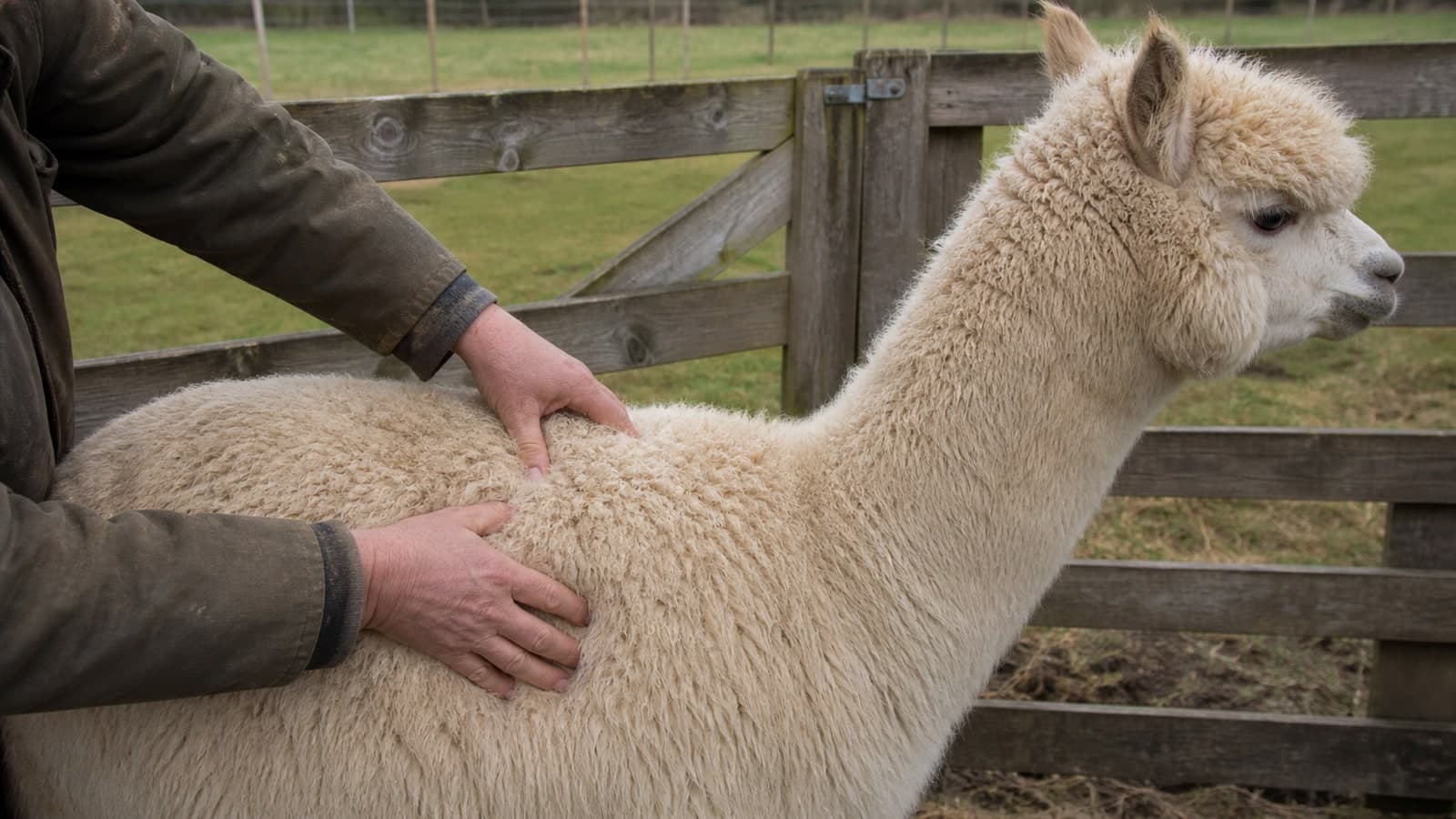
An alpaca's fleece hides its body condition. Under a full fleece, an underweight alpaca can look much like a well-covered one. If you rely on the eyeball test to guess how much to feed alpacas, you can easily misjudge it. A more reliable way is to track the Alpaca body condition score (BCS) using hands-on palpation and a digital scale (which you can calculate using our interactive Alpaca Body Condition Score Calculator). This guide gives you the anatomical rules and the feed adjustments you need to maintain herd health and safely hit your target alpaca winter weight before severe weather strikes.
1. The Visual Myth
Judging condition by eye is unreliable in alpacas. An alpaca's dense fleece operates as an opaque thermal envelope that hides the body underneath. As detailed in our when to shear alpacas guide, shearing day is the only day the animal's true skeletal geometry is exposed visually.
A year between hands-on checks lets changes go unnoticed for too long. Instead of relying on visual estimates, check the Body Condition Score (BCS) by hand every month and confirm the trend with regular weights on a digital livestock scale.
2. The Alpaca Body Condition Score Palpation Rule
Because you cannot see the condition, you must put your hands on the animal. The industry-standard BCS operates on a 1 to 5 scale: 1 represents critical emaciation, 3 is the biological ideal, and 5 is obese.
Do not rely on the hips or pelvis to judge condition. Feeling there can make a well-conditioned animal seem thin.
The Palpation Method:
- Stand parallel to the restrained animal.
- Place the flat base of your palm firmly over the mid-back, halfway between the neck and the tail.
- Press downward with enough force to completely compress the fiber and eliminate air pockets.
- Use your fingers and thumb to map the angle between the dorsal spinous processes (the vertical spine ridge) and the transverse processes (the horizontal short ribs sticking out the sides).
Scoring the Geometry:
- BCS 1 to 2 (Underweight): The geometry is severely concave. Your hand falls into a deep depression, and the short ribs form a sharp, abrupt horizontal shelf.
- BCS 3 (Optimal Maintenance): The musculature forms a smooth, even line. Your hand rests on a clean, uninterrupted slope that is neither sharply peaked nor flat.
- BCS 4 to 5 (Overweight/Obese): The geometry is convex and bulging. The spine is completely buried beneath a thick plateau of fat, creating a flat "tabletop" appearance.
3. Fixing the Underweight Alpaca: Hitting Your Alpaca Winter Weight
An underweight alpaca has less subcutaneous fat to buffer it against the cold, so winter weather is harder on it. If your scale and palpation confirm a BCS of 2.0, act promptly to hit a safe alpaca winter weight before extreme storms hit.
Moving an alpaca a full point on the BCS scale takes a real change in body weight - as a rough rule of thumb, on the order of a tenth of its body weight, which for a typical adult female is several kilograms. So, exactly how much to feed alpacas to drive that gain?
The Dry Matter Feed Rule: You cannot fix a BCS 2.0 by simply throwing more low-quality grass hay in the feeder. Stomach capacity is strictly limited by physical gut fill. To drive weight gain, bump their daily Dry Matter Intake (DMI) from a maintenance level of around 1.5% up to 2.0% to 2.5% of their body weight. This means introducing highly digestible, energy-dense concentrates (like oats, lupins, or high-protein alfalfa) to get past the physical limits of their stomach.
The Cold Stress Penalty: Cold weather quietly steals the calories you meant for weight gain. A dry, full fleece is excellent insulation, so a well-conditioned alpaca copes with surprisingly low temperatures on its own. Two things change that:
- A thin animal has little fat to burn and a thinner coat, so it feels the cold sooner and needs more energy just to hold its temperature.
- A wet coat makes it harder. A fleece soaked by cold rain or sleet keeps the animal less warm than a dry one, so a wet, thin alpaca in a winter storm can lose condition faster.
In cold, wet, or windy spells, feed more, lean on energy-dense feed, and make sure the herd has a dry, draft-free place to shelter so they are not spending those calories just staying warm.
4. Why Overweight Alpacas Can Struggle in Heat (BCS 5 to 4)
Conversely, a BCS of 5.0 is a real risk in July: the Merck Veterinary Manual names obesity among the factors that can predispose llamas and alpacas to heat stress.
Fat Can Raise the Risk: The Merck Veterinary Manual lists obesity among the things that can predispose llamas and alpacas to heat stress, alongside subclinical disease (illness without obvious signs), stress and overcrowding. That is why the weight comes off before summer, not during it. For the signs of heat stress, how to cool your herd and what to do in an emergency, read our guide to alpacas in hot weather.
The Safe Reduction Rule: You do need to take fat off before summer, but avoid a sudden, severe cut in feed. Safe weight loss is slow, so begin a modest feed reduction well before the summer heat rather than dieting at the last minute.
5. The Digital Ledger
Small changes in condition are easy to miss. Trying to track fractions of a BCS point and shifting seasonal feed needs on an analog clipboard is how animals slip through the cracks.
The protocol for a modern farm is dual-stream data capture: the tactile 1 to 5 BCS palpation over the lumbar spine, recorded alongside the animal's absolute mass on a digital livestock scale.
This is exactly why we built AlpacaKeep - a herd-management tool that tracks these exact metrics over time so trends are obvious before they become emergencies.
AlpacaKeep is built and run on a working alpaca farm and is in private beta now for farms in the EU, the UK, Australia and New Zealand, with every feature free for the beta farms. The Free plan for up to 10 animals stays free afterwards. Get early access. Our free record-keeping templates are yours to download too, with no signup.
Sources & Further Reading
- Van Saun, R. J. Body Condition Scoring of Llamas and Alpacas. Penn State Extension.
- Wagener, M. G., Ganter, M., & Leonhard-Marek, S. (2024). Body condition scoring in alpacas (Vicugna pacos) and llamas (Lama glama) - a scoping review. Veterinary Research Communications.
- Wiedner, E. Diseases of Llamas and Alpacas: Heat Stress of Llamas and Alpacas. Merck Veterinary Manual.
- Cebra, C., Anderson, D. E., Tibary, A., Van Saun, R. J., & Johnson, L. W. (2014). Llama and Alpaca Care: Medicine, Surgery, Reproduction, Nutrition, and Herd Health. Elsevier (nutrition and hepatic lipidosis chapters).
- Rocky Mountain Llama and Alpaca Association (RMLA). Hypothermia in Alpacas and Llamas.