 AlpacaKeep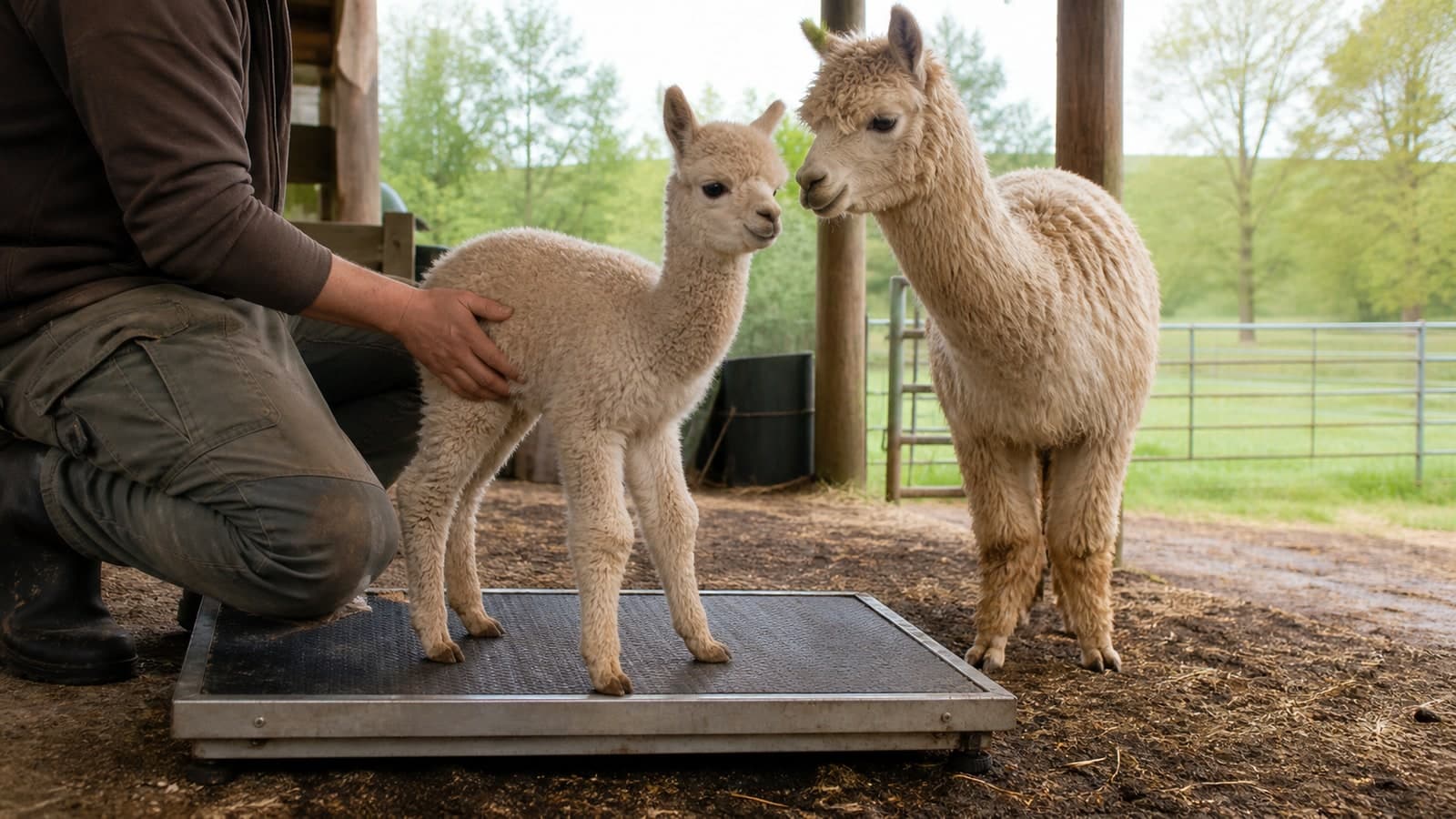
The first few weeks after unpacking are the highest-stakes period of camelid farming. A breeder's most immediate anxiety is whether the newborn cria is thriving or slowly failing. Visual assessments are often useless; a fluffy fleece can easily hide a dangerously emaciated skeletal frame. While evaluating adult body condition is done by palpation (using the Alpaca Body Condition Score Calculator), keeping track of a growing cria takes a digital scale and a record of every weigh-in.
Here are the published veterinary benchmarks for healthy alpaca and llama growth during the critical first 60 days, and the signs that mean it is time to call your vet.
1. The Birth Weight Baseline
A cria's birth weight is one of the best early signs of how well it will do.
- Alpacas: The normal range is 7 to 11 kg. Crias born under about 6 kg count as low birth weight and need immediate, intensive monitoring.
- Llamas: The normal range is 9 to 15 kg. Under about 7 kg counts as low birth weight.
2. The First Days: The Normal Dip
Do not panic if your cria does not gain in its first days. Crias gain very little in the first 24 hours, and many do not gain at all in the first three days while they pass meconium (usually within the first 18 hours) and the dam's milk comes in fully. The Alpaca Association of New Zealand notes the weight may drop by up to about 10% in the first couple of days.
That dip is a normal pattern, not a safety margin. Weigh the cria every day through the first month, and if the weight keeps falling, or the cria is sluggish, resting more and drinking less, call your vet rather than waiting for a number to tell you.
Your primary concern on Day 1 is passive transfer. The cria needs to drink colostrum early (ideally within the first few hours) and take in about 10% to 15% of its body weight in colostrum within the first 24 hours, ideally by 12 hours, to absorb the necessary immunoglobulins (IgG). For a cria that cannot suckle, see newborn cria emergencies.
3. The 60-Day Growth Curve (Average Daily Gain)
Once the milk is in, weigh the cria at about the same time each day, ideally before a feed, so you can work out the Average Daily Gain (ADG) over several days rather than from one reading to the next.
- Alpaca ADG: The Merck Veterinary Manual gives 100 to 250 grams per day.
- Llama ADG: Merck gives 250 to 500 grams per day.
With good nutrition, a healthy cria roughly doubles its birth weight by about one month of age. The Alpaca Association of New Zealand describes a similar pace as about 1 to 1.5 kg a week, or about 6 kg in each of the first two months.
These ranges describe healthy crias. They are not a pass/fail line: a single slow day means little, and a small scale can read a little differently from one weigh-in to the next.
4. When to Call Your Vet
Intervening too early with a bottle can disrupt the maternal bond, but intervening too late risks a fading cria. There is no published cut-off (so many days without gain, or so many percent lost) that decides it for you, so do not wait for one. Call your vet if you see any of these:
- The cria keeps losing weight after the first few days, or does not start gaining once the milk should be in.
- The weights stop rising, or fall clearly behind the pace above, across several weigh-ins.
- The cria is sluggish, rests more, drinks less, or has a weak suckle, whatever the scale says.
Your weight record is what makes that call useful: a vet can do far more with a week of daily weights than with "I think it looks thin".
5. The Emergency Bottle Feeding Protocol
If the dam's milk has failed, supplemental feeding is worked out from the cria's body weight to avoid overfeeding, which can cause severe colic or diarrhea. Agree the plan with your vet.
- Volume: Veterinary guidance puts it at about 10% to 15% of the cria's body weight per 24 hours.
- Frequency: Divide this total volume into small, frequent feeds, every 2 to 4 hours at first, then gradually fewer night feeds as the cria grows.
- Execution: Never force-feed. Feed the cria upright or cushed on its brisket, the way it would nurse from the dam, with its head and neck straight and in line with its body, and let it suck and swallow at its own pace. Never feed a cria lying flat or with its head tipped back. When a cria suckles like this, a reflex closes the esophageal groove and routes the milk to C3, the true stomach. Milk that ends up in C1, the large fermentation forestomach, instead ferments there and can cause acidosis. Milk pushed in too quickly can also be inhaled into the lungs. If the cria has no suckle reflex, stop and call your vet rather than pouring milk in.
| Weight | Min daily (10%) | Max daily (15%) | Per feed |
|---|---|---|---|
| 7 kg | 700 ml | 1000 ml | 60–120 ml every 2–4 hrs |
| 9 kg | 900 ml | 1350 ml | 90–120 ml every 2–4 hrs |
| 11 kg | 1100 ml | 1700 ml | 90–150 ml every 2–4 hrs |
| 14 kg | 1400 ml | 2000 ml | 150–210 ml every 2–4 hrs |
6. Spring Parasite Risks
In the UK and similar climates, spring births coincide with a rise in parasite risk. The British Alpaca Society lists Nematodirus battus among the parasites that most often cause problems in UK alpacas, and warns that worm eggs lying on pasture over winter can hatch in huge numbers when the weather warms in spring. Scouring and weight loss in young grazing crias are the result.
The coccidian Eimeria macusaniensis is another one to know. In a clinical study of 49 affected llamas and alpacas, the signs were often vague and frequently showed up before fecal tests turned positive. A sudden, unexplained slowdown in your cria's growth is a good reason to take a fecal sample to your vet, even when the cria still looks well.
That is why we built AlpacaKeep: it stores each weight on the cria's timeline and shows the growth curve, so a slowdown is easier to catch and share with your veterinarian.
AlpacaKeep is built and run on a working alpaca farm and is in private beta now for farms in the EU, the UK, Australia and New Zealand, with every feature free for the beta farms. The Free plan for up to 10 animals stays free afterwards. Get early access. Our free record-keeping templates are yours to download too, with no signup.
Sources & Further Reading
- Wiedner, E. Herd Health of Llamas and Alpacas. Merck Veterinary Manual.
- Towcester Veterinary Centre. Newborn Cria Care.
- Camelid Veterinary Services. Feeding Guide for Crias.
- Alpaca Association New Zealand. Neonatal and Cria Care.
- Roberson, J. Sick cria management: the Tennessee method (Proceedings). dvm360.
- British Alpaca Society. Alpaca Fact Sheet #11: Alpacas and Parasites (reviewed 2018).
- Cebra, C. K., et al. (2007). Eimeria macusaniensis infection in 15 llamas and 34 alpacas. Journal of the American Veterinary Medical Association, 230(1), 94-100.
- Bravo, P. W., Garnica, J., & Puma, G. (2009). Cria alpaca body weight and perinatal survival in relation to age of the dam. Animal Reproduction Science, 111, 214-219.
- Ablondi, M., Sabbioni, A., Esposito, G., Beretti, V., & Asti, V. (2023). Body measures, growth curves and body weight prevision of alpacas (Vicugna pacos) reared in Italy. Italian Journal of Animal Science, 22(1), 1196-1204.