 AlpacaKeep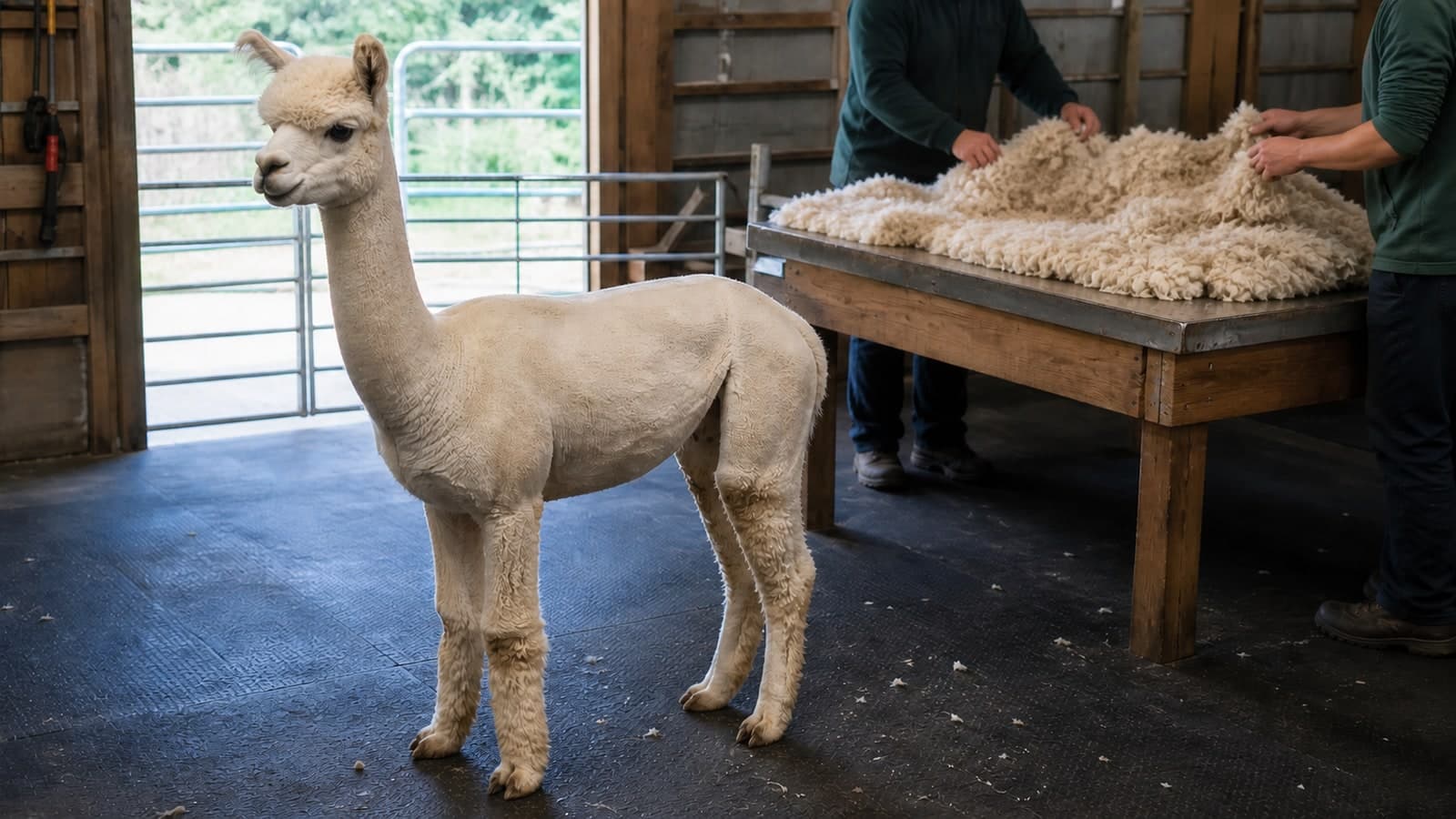
The shearing date matters for your herd's health. Shear too early and a cold snap catches a freshly shorn animal without the fleece that keeps it warm. Shear too late and hot, humid weather catches the herd in full fleece. Unshorn camelids are more prone to heat stress, which is an emergency and can be fatal.
Most online guides hand you a calendar month and call it advice. "Shear in May" is fine for one farm in central England and dangerous for the same herd if it lives at 1,200 metres in South Tyrol. The right answer is the same everywhere - a temperature rule - but the date that rule lands on depends entirely on where you farm.
If you are wondering when to shear alpacas, here is the rule, the climate-indexed calendar, the edge cases that catch farmers out every year, and the husbandry checklist that turns shearing day into the single most useful 30 minutes per animal you will spend all year.
The Anchor Rule
Shear in late spring, after hard frosts have passed. As a rough guide, get it done before daytime highs stay above about 27°C for several days in a row. If a late cold snap follows, protect freshly shorn animals with coats and overnight housing rather than delaying the shear.
That is the rule of thumb, and the heat side is the one to take most seriously.
The 27°C figure is a practical rule of thumb, not a measured threshold. What the sources do describe is why heat matters: heat stress can occur in animals with moderate to heavy fiber coats in hot, humid weather (Merck Veterinary Manual), and alpacas do not shed, so the fleece stays on until they are shorn. Camelids can release heat through thermal windows, the thinly haired belly, armpits and inner thighs (Gerken, 2010), and in hot, humid weather an unshorn animal is left with only breathing and sweating to cool itself (Norton et al., 2014).
Heath et al. (2001) compared shorn and unshorn animals in a study of eight male alpacas in Alabama. In the shorn animals, rectal temperature still rose with the air temperature (r = 0.823 in the morning); for the unshorn animals the study reports a morning correlation of r = 0.612. But shearing helped: the shorn animals tended to have lower rectal temperatures in high heat, and their medial-thigh surface temperatures sat 0.9°C cooler in the morning and 1.6°C cooler in the afternoon than the unshorn group.
Shearing also removes the fleece that keeps the animal warm, so a freshly shorn alpaca has less protection against cold until the fleece grows back. A study of healthy alpacas in the Italian Apennines at 300 metres' altitude (Mattiello et al., 2011) found summer morning rectal temperatures in adults averaging 36.3°C (probably because the animals had recently been shorn), and a lowest reading of 35.1°C across all the seasons and times of day measured. Our advice is not to wait for warm nights before shearing, because in cool temperate climates that delays you straight into summer heat. Instead, shear on schedule and buffer the cold with lightweight coats and a draft-free barn until the fleece begins to regrow.
With the heat deadline in mind, the practical question becomes: when does my zone hit the safe shearing window?
When to Shear Alpacas and How Often
Once a year, every year. Alpacas were selectively bred in the Andean highlands for fleece dense enough to keep them alive at 4,000 metres - and unlike sheep, they do not shed. Without a shearer, last year's fleece is still on the animal twelve months later, and it keeps growing.
Why not less. Skipping a year produces three predictable failures. The inner coat felts into a near-rigid mat that no comb or carder can salvage, and most processors refuse the fleece outright. A second summer unshorn means another hot season under a full coat, and unshorn camelids are more prone to heat stress, which can be fatal. And next year's shearer second-cuts every animal because no blade takes 24 months of growth in a single clean pass.
Why not more. Twice-yearly shearing is rare, and for most farms it does not pay. Processors want a 7-10 cm staple length; shearing twice a year produces 4-6 cm staples that are uneconomic to spin. The narrow exception is hot equatorial climates - parts of northern Australia, equatorial Africa - where some farms accept the fiber-value loss for a welfare buffer against year-round heat. For temperate and Mediterranean farms, one shear per year is correct.
The cost of skipping. A 5 kg single-year fleece worth €30-80/kg - the exact figure depends on how fiber is graded and what drives the price - becomes a 9-10 kg matted, second-cut-prone fleece worth €5-15/kg next year - if any processor will take it.
The Climate Calendar
These windows are starting points. Always check your local 14-day forecast against the anchor rule before committing.
Subtropical and hot humid
Examples: US South, parts of northern Australia, North Italian lowlands. Window: February to early April.
Hot, humid weather leaves an unshorn alpaca with few ways to shed heat (Norton et al., 2014), so aim to have the herd shorn before the humid weather arrives. Book a shearer who can come early and pair shearing with strong barn ventilation in the weeks afterward.
Mediterranean
Examples: southern Italy, Iberia, southern France, coastal California. Window: mid-March to late April.
Last hard frosts are gone by early March; daytime highs cross 27°C reliably from mid-May. The Mediterranean window is short but predictable.
Cool temperate
Examples: UK, Ireland, north-western Europe, US Pacific Northwest, US Northeast. Window: April to June. (New Zealand's South Island shares this cool-temperate climate but follows the Southern-Hemisphere calendar below.)
This is the standard "spring shearing" zone most online guides write about. Watch the forecast: a late frost in May is more common than the calendar suggests. The Australian Alpaca Association recommends booking 12 months ahead in busy regions; in the US Northeast, contact a shearer by the end of February for a May or June slot.
Continental
Examples: US Midwest, Great Lakes, Eastern Europe, central Canada. Window: late April to June.
Humid summers arrive fast. Most Great Lakes breeders shear in April, May, or June and have the herd stripped before the first humid week.
Alpine and high-altitude
Examples: Swiss, Austrian and Italian Alps, Rocky Mountains, high Andes. Window: late May to late June.
Frost can occur in any month at altitude, so this is the one zone where you genuinely wait for settled late-spring weather before shearing. Even then, have lightweight alpaca coats and a draft-free barn ready for the first cold nights after shearing.
Southern Hemisphere
Examples: Australia, New Zealand, South America, South Africa. Window: September to March.
Mirror calendar. New Zealand's professional shearing season runs October through end of March; Australian timing varies by region but generally September to November. Coastal NSW operations sometimes start earlier where there is no frost risk. Booking lead time is the same: 6 to 12 months ahead in busy areas.
Booking: why winter is when you book
Professional alpaca shearers travel multi-farm regional routes to keep blades efficient and travel costs manageable. Most of them are booked solid by the time spring arrives. The Australian Alpaca Association and several US regional associations recommend confirming your shearer 6 to 12 months out, not 6 to 12 weeks. If you have a small herd, the cleanest move is to coordinate with neighbouring farms so the shearer can hit several properties on a single route - this is often the only way to secure a slot in popular regions.
If you missed the booking window: ask your local breeders' association for a shearer who covers your zone late in their route, and stay flexible on the exact day.
The Two-Week Pre-Shearing Checklist
14 days before: confirm the booking. Brush or use a livestock blower on the dirtiest fleeces to dislodge embedded vegetation, sand, and dust. Clean fleece extends blade life and lifts the commercial grade of the fiber.
7 days before: watch the forecast. If rain is likely, plan to shed the herd indoors the night before shearing day. Wet fleece is unprocessable, makes the animal dangerously slippery on the mat, and develops mould inside storage bags within hours.
1 to 2 months before: if you vaccinate yearly (CD&T or your regional equivalent), do it now, so shearing day is only for shearing. Take baseline body condition scores at the same visit; the dense fleece masks both emaciation and obesity until the animal is naked. This pre-shearing visit is a natural checkpoint to fold into the wider husbandry routine.
24 hours before: clean paddock, dry barn. Remove free-choice hay 12 hours before the appointment. A full rumen pressing against the diaphragm during lateral restraint causes acute respiratory distress and panic. Water restriction varies by shearer - ask. Most restrict water for 12 hours; none restrict longer.
Day Of: The 30-Minute Window
A professional shearer takes about 5 to 10 minutes per animal once the alpaca is on the mat. With prep, transition, and concurrent husbandry tasks, plan on 20 to 30 minutes per animal of focused work.
Restraint method matters. A 2017 study by Wittek and colleagues at the University of Veterinary Medicine Vienna compared three ways of holding an alpaca: standing, cast on the ground, and on a tilt table. First, 15 alpacas were restrained all three ways without being shorn; then 45 alpacas were shorn, 15 with each method. The team measured body temperature, heart rate, breathing rate, cortisol in saliva and cortisol breakdown products in the dung.
Without shearing, standing was the least stressful of the three methods. During shearing, temperature, heart rate and breathing changed over time but did not differ between the methods, and the number of injuries was similar. Cortisol breakdown products in the dung rose in all three groups, while cortisol in saliva rose only in the alpacas shorn on the ground; values varied widely from animal to animal. The authors recommend shearing calm alpacas standing, and shearing animals that fight back hard either cast on the ground or on a table, to lower the risk of injury. Ask your shearer which method they use and why; the right answer depends on the animal's temperament.
Social buffering matters too. Alpacas are herd animals. Keep herdmates within sight, sound, and smell of the animal being shorn, and keep a nursing dam's cria close enough to see her during the procedure. This is the advice of the Italian Società Nazionale Alpaca e Lama (SNAEL).
Shearing-Day Husbandry: Eight Things You Should Be Doing
Shearing day is the only day all year your animals are immobilised, naked, and observable centimeter by centimeter. Use it.
- Toenail trim. Flush with the soft pad, a little at a time. You can do this 3 to 4 times per year, but at minimum, today.
- Fighting teeth check. Males develop the six hooked fighting teeth at around 2 to 3 years of age. They keep growing throughout life, so check them every year and trim as needed - many males need more than one trim.
- Body condition score. 1-to-5 scale, palpate over the spine and ribs. Use our interactive Alpaca Body Condition Score Calculator to determine and track the score. Document the number - without the fleece, the animal's true condition is finally visible.
- Mid-side fiber sample. Small ziplock per animal, label with ID. Send for micron testing if you sell fiber commercially.
- Weight check. Set up a livestock scale next to the mat. The number is far more accurate than your monthly visual estimate.
- Microchip scan. Five seconds. Confirms identity for registry compliance and catches any chips that have lost signal or migrated.
- Record photo. Conformation is impossible to assess through a year's worth of fleece. Today is the only honest photograph you will take all year.
- Vaccination check (administered 1 to 2 months earlier, not today - see above).
Three-Bag Fiber Processing
If you intend to do anything with the fleece beyond composting it, organise the harvest as you go. Three labelled bags per animal:
- 1sts (blanket): the prime fiber from the body - finest, most uniform, lowest guard hair. 7.5 to 18 cm staple length. This is the high-value clip. Move it off the mat before the shearer starts on the legs and apron.
- 2nds: neck and upper legs. Slightly coarser, 3.8 to 12.7 cm staple. Acceptable for yarn, valuable for blends.
- 3rds: lower legs, apron, heavily contaminated trimmings. 3.8 cm and up, highest guard-hair content. Useful for felting and rug-making.
The catastrophic failure mode is letting blanket fleece sit on the mat while the shearer cuts the apron - coarse leg hair contaminates the prime clip and downgrades the entire blanket. For show-grade fleeces, lay paper sheets and "noodle" (carefully roll) the blanket intact to preserve staple architecture.
Edge Cases
Pregnant dams
Shear with the rest of the herd. The Merck Veterinary Manual lists heat stress among the causes of abortion in llamas and alpacas, which is a good reason not to leave a pregnant female in full fleece through the summer. Ask the shearer for gentle handling rather than skipping a pregnant female.
Crias and the maternal-bond rule
Wait at least 30 days post-birth before shearing a cria. Maternal scent recognition is established in the first weeks; a freshly-shorn cria can smell wrong to its dam, which has caused rejection on some farms. Do not shear the tail - that is the scent anchor the dam imprints on. Only shear during warm months, and provide a coat and overnight housing if a cold snap follows.
Yearlings (tuis)
Pallotti et al.'s 2020 randomised trial settled the long-running argument about first full shearing. Twenty Huacaya alpacas split into two groups: one shorn at exactly 10 months of age, the other left fleeced. Six months later, the shorn group had grown 7.71 cm of new fiber against 4.29 cm in the unshorn controls - +79.7% more growth, with no statistically significant difference in fiber diameter or secondary-to-primary follicle ratio. Early shearing does not cost you fineness; it actively stimulates follicular activity. Yearlings should be in the standard shearing rotation.
Geriatric or sick animals
Skilled shearers will adapt - softer surface, faster session, sometimes a recommendation to skip the day and rebook. But postponement carries its own heat-stress risk through the summer that follows. Talk to the shearer in advance; the right call is rarely "skip this year."
Two-year fleeces
Do not. Annual shearing is not an aesthetic preference - it is a welfare baseline. A two-year fleece risks matting (which causes clipper burn the following year because alpaca skin lacks lanolin), heat stress, and "second cuts" that destroy commercial value. The few farms that intentionally hold a fleece for two years for specific show or textile purposes use coats and air-conditioned barns through summer; this is not a default option.
Unscheduled rain
If the morning of shearing dawns wet - animals were not shed overnight - call the shearer. Do not shear a wet fleece. Most professionals will rebook rather than risk a slip injury. If the shearer travels long distances, they may charge for the visit; this is fair, and far cheaper than an injured animal or a mouldy fleece harvest.
Post-Shearing Care
The first 72 hours after shearing are the riskiest of the year for two reasons most farmers do not expect.
Sunburn. Alpaca skin under fleece sees no sun for a year. Light-coloured animals - whites, fawns, light greys - are at real risk of sunburn for the first three to five days after shearing. Provide deep shade, and consider an animal-safe sunscreen on the ears and bridge of the nose for the lightest individuals.
Clipper burn. Alpaca skin has no lanolin. Even the cleanest shearing cuts can produce raw, weeping clipper burns, especially on animals whose fleece was matted or carried embedded vegetation. The wounds take up to two weeks to heal. Inspect each animal before they go back to the paddock and flag anything red or weeping for daily monitoring.
Other essentials. Fresh water with electrolytes. Avoid rough terrain or aggressive paddock-mates for the first 48 hours - a dominant herd member who tolerated yesterday's hierarchy may suddenly bully today's stranger-shaped animal. If your nights are still cold, fit lightweight alpaca coats and shed the herd indoors overnight for the first week.
What to Write Down
Six fields per animal turn shearing day from chaos into a year of useful data:
- Date sheared.
- Body condition score (1 to 5).
- Body weight (kg).
- Total fleece weight (kg, blanket + seconds + thirds).
- Mid-side micron sample - yes/no, and where you sent it.
- Husbandry done today - toenails, teeth, vaccinations, photo, microchip.
That is why we built AlpacaKeep: it keeps each animal's shearing date, fleece result, and next seasonal task together, so the right job appears before the weather window closes.
AlpacaKeep is alpaca herd management software, built and run on a working alpaca farm and in private beta now for farms in the EU, the UK, Australia and New Zealand, with every feature free for the beta farms. The Free plan for up to 10 animals stays free afterwards. Get early access. Our free record-keeping templates are yours to download too, with no signup.
For a cleaner view of when next year's pregnancies will need cria watch in parallel with the next shearing season, we built a free gestation calculator - paste a mating date, get the safe window. The two annual rhythms (shearing and unpacking) usually overlap; planning them on the same calendar saves you the worst weekends.
Sources & Further Reading
- Heath, A.M., Navarre, C.B., Simpkins, A., Purohit, R.C., Pugh, D.G. (2001). A comparison of surface and rectal temperatures between sheared and non-sheared alpacas. Small Ruminant Research.
- Wiedner, E. Diseases of Llamas and Alpacas: Heat Stress of Llamas and Alpacas. Merck Veterinary Manual.
- Ciccarelli, M. Abortion in Camelids. Merck Veterinary Manual.
- Gerken, M. (2010). Relationships between integumental characteristics and thermoregulation in South American camelids. Animal.
- Norton, P.L., Gold, J.R., Russell, K.E., Schulz, K.L., Porter, B.F. (2014). Camelid heat stress: 15 cases (2003-2011). Canadian Veterinary Journal.
- Mattiello, S., Formis, E., Barbieri, S. (2011). Thermoregulation of alpacas bred in Italy. International Journal of Biometeorology 55(2), 213-218.
- Wittek, T., Salaberger, T., Palme, R., Becker, S., Hajek, F., Lambacher, B., Waiblinger, S. (2017). Clinical parameters and adrenocortical activity to assess stress responses of alpacas using different methods of restraint either alone or with shearing. Veterinary Record.
- Pallotti et al. (2020). A comparison of fleece quality and follicular activity between sheared and non-sheared yearling alpacas.
- Australian Alpaca Association - shearing
- Alpaca Association New Zealand - shearing
- Rocky Mountain Llama and Alpaca Association - heat stress
- Società Nazionale Alpaca e Lama (SNAEL) - tosatura