 AlpacaKeep
If you keep cattle or sheep for meat, you can get away with a fuzzy memory of who bred to whom. Alpacas are different. The whole industry is built on fleece and genetics, not slaughter weight, and the pedigree side of the business runs on closed national registries with no new wild blood coming in. That means every mating you record either protects your herd's genetics or quietly erodes them.
This is the part of breeding that doesn't announce itself. A pedigree mistake doesn't make a noise in the paddock. You find out a year later when a female "just didn't take," or three years later when a buyer's vet spots something in the bloodline. Good alpaca pedigree tracking is how you see those problems before they cost you.
This guide covers what a pedigree actually is, how to read an inbreeding coefficient without a genetics degree, and the record-keeping habits that keep your herd registrable and valuable. It's written for beginners and seasoned breeders alike. If you just want the rules, start with the 30-second version and come back for the why.
The 30-Second Version
If you read nothing else, read this:
- Track at least five generations. Short pedigrees lie. They can show a healthy 0% inbreeding coefficient while real shared ancestry hides one generation deeper.
- Keep the inbreeding coefficient (COI) low. Under about 6% is comfortable. Above about 12% you need a strong, deliberate reason.
- Linebreeding and inbreeding are the same biology. One is planned, one isn't. Both concentrate genes, good and bad.
- The dam's owner on the day of birth is usually the only person who can register the cria. Never buy an unregistered pregnant female assuming you can register her offspring later.
- Register early and DNA test. Most registries charge more the longer you wait, and DNA confirms the parents you wrote down are the real ones.
- Very low birth weight is the real cria warning sign, not a fancy average. Watch any cria born light and make sure it gets colostrum fast.
The rest of this article explains each of these.
Why Pedigree Tracking Matters More for Alpacas
Most alpacas belong to a national registry, and those registries are closed. No outside or wild genetics come in. Picture a swimming pool that never gets fresh water. Everything already in the pool just keeps mixing. Over enough generations, animals that look unrelated on paper actually share a surprising amount of ancestry.
That matters because alpacas are bred for fine, consistent fleece, and the traits you're chasing (fineness, density, crimp, luster) are genetic. The only way to improve them reliably, or to avoid wrecking them, is to know exactly what's behind each animal. A pedigree isn't paperwork for its own sake. It's the map you use to make every breeding decision.
Inbreeding vs Linebreeding: Same Biology, Different Intent
Breeders love to draw a line between "linebreeding" (respectable) and "inbreeding" (a dirty word). Genetically there's no difference. Both deliberately increase the chance that a cria inherits two identical copies of a gene from a shared ancestor.
The honest distinction is intent and control:
- Linebreeding is planned. You concentrate a specific outstanding ancestor's genes on purpose, monitoring the numbers as you go, to lock in good traits. Done carefully, it produces animals that breed true and pass their quality on predictably.
- Inbreeding, as most people use the word, is the unplanned or unmonitored version. Same mechanism, no map.
Here's the key thing: breeding relatives doesn't create defects. It just raises the odds that two hidden harmful genes, already lurking in the bloodline, finally meet in the same cria. Many inherited defects come from these hidden recessive genes. That's why the safest default strategy, especially for beginners, is outcrossing: deliberately breeding unrelated animals to keep diversity high and faults buried.
The Inbreeding Coefficient (COI), in Plain English
The inbreeding coefficient, or COI, is a single percentage that answers one question: how likely is this cria to inherit two identical copies of the same gene because its parents share ancestors? It was worked out by the geneticist Sewall Wright back in the 1920s and it's still the standard tool today.
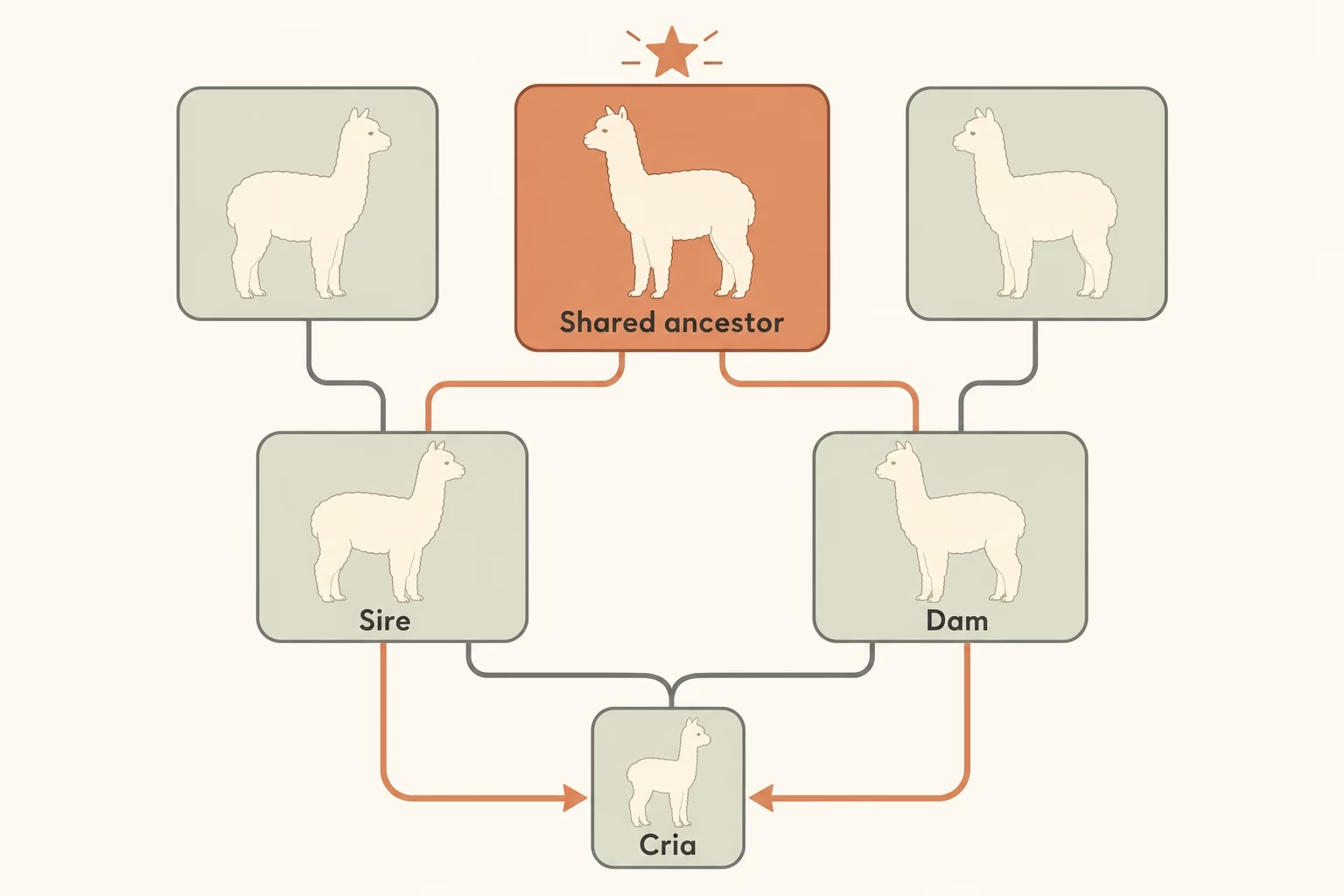
The diagram below shows the simplest case. The sire and the dam share one parent, which makes them half-siblings, the kind of pairing that lands around 12% on the scale below.
You don't need to do the math by hand. What you need is a feel for the numbers:
These are widely used rules of thumb borrowed from decades of animal breeding, not laws. No alpaca registry enforces a hard COI limit. But many breed societies' codes of conduct do require you to disclose linebred or inbred stock to a buyer, and a clean, low COI is a genuine selling point that feeds straight into what a well-bred animal is worth. A buyer who can see the number trusts the animal more.
It also helps to keep perspective. Across whole populations, measured alpaca inbreeding is usually low. Pedigree analyses of registered North American alpacas put the average under 1%, a large Peruvian herd averaged about 0.17%, and a 2021 study of alpacas in Poland found high genetic diversity with an average inbreeding of roughly 3.4% and, in the authors' words, no sign of an unfavourable inbreeding problem. So this isn't a species-wide crisis. The danger is the individual mating that quietly runs hot, and the shared ancestry that a short pedigree hides. That is exactly what your COI check is for.
The Hidden Trap: Short Pedigrees Lie
This is the mistake that catches almost everyone once.
A COI is only as honest as the pedigree behind it. If you only record two or three generations, the calculator simply can't see the shared ancestors sitting further back, so it reports a reassuring low number. Breeders call this cryptic inbreeding: real shared ancestry, hidden by a shallow pedigree.
It's especially common in alpacas because so many national herds trace back to a small group of imported founders. Go back far enough and a lot of "unrelated" animals meet at the same handful of names.
The fix is depth. Five generations is the practical minimum for a COI you can trust. Eight to ten gives you real confidence. The catch is that you'll never own most of those ancestors, and that's fine. You don't need to. You just need their names and links in the pedigree so the math can find the overlaps. (More on how to do that without drowning in data entry in the AlpacaKeep section below.)
What Inbreeding Actually Costs You
Inbreeding's effects show up in three areas. The evidence is solid for one of them and genuinely unsettled for the others, so here's the honest version of each.
1. Lighter fleeces
A large study of more than 12,000 alpacas in Peru found that fleece weight dropped a little with every 1% rise in COI, on the order of 11 grams per 1%. On any single animal that's tiny. The point isn't one fleece. It's that the effect is real, it's measurable, and it stacks quietly across a whole herd, year after year, on top of the more serious effects below.
2. Cria birth weight and survival
Here the picture is more nuanced. That same large Peruvian study found inbreeding's effect on birth weight specifically was not statistically significant, so don't assume a slightly inbred cria will be born small. What is beyond doubt is that birth weight itself is one of the strongest predictors of whether a cria survives its first weeks. One study of crias under tough, extensive mountain conditions found survival climbed steeply with birth weight:
Read this the right way. The lesson is not "every cria must be born over 7 kg." Plenty of healthy crias are born lighter than that. The lesson is that a very low birth weight is a genuine red flag. A light cria needs warmth, a fast first feed of colostrum, and close watching. Whatever the weight, getting colostrum into a newborn quickly matters even more than the number on the scale. Our cria watch calculator helps you plan for the days around birth.
3. Congenital defects (and what the research really says)
This is the severe end, and it's also where a lot of breeding folklore outruns the science, so it's worth being precise. Camelids are prone to several congenital defects, including choanal atresia (a failure of the nasal airway to open, which leaves a newborn struggling to breathe), wry face, heart wall defects, fused or extra toes, and underdeveloped reproductive organs. Most registries disqualify affected animals to keep these faults out of the breeding pool.
Now the honest part. Researchers have not shown that general inbreeding causes these defects. An Australian study (Jackling and colleagues) compared affected and healthy alpacas and found the affected ones did not have significantly higher inbreeding. And the leading candidate gene for choanal atresia, CHD7 (the gene behind CHARGE syndrome in people), was investigated by a University of Minnesota team and largely ruled out as the primary cause. The genetic basis of most camelid defects is still being worked out.
So why does pedigree tracking still help here? Two reasons. These faults clearly cluster in certain families even though the exact mechanism is unsettled, so knowing the lineage lets you steer around known problem lines. And the one group of defects with a proven genetic cause is colour-linked: the grey-on-grey and white-spot pairings that silently end pregnancies or leave crias deaf. Those you can predict and avoid outright. We cover them in detail in Alpaca Coat Genetics: The Pairings That Quietly Kill Pregnancies.
What a Useful Pedigree Record Actually Contains
A pedigree is only useful if it captures the right things. For each animal, you want:
- Sire and dam, linked to their own records (not just typed-in names).
- Date of birth and sex.
- Permanent ID: the ISO microchip number, plus any ear tag or tattoo.
- Registry and registration number, once registered.
- Colour, ideally with any DNA colour-genotype results.
- DNA case number from parentage or colour testing.
- The chain of custody: who owned the dam when this animal was born. This one detail decides whether a cria can be registered at all.
If you have all of this for an animal and its ancestors, you can calculate a trustworthy COI, prove parentage to a buyer, and stay on the right side of any registry.
Registries and Why Records Are Non-Negotiable
Wherever you farm, the registry is the gatekeeper of an animal's value, and they all run on the same logic even though the details differ. Europe works through national and breed associations: the British Alpaca Society is one of the largest, and Germany, Italy, and other countries run their own. North America has the Alpaca Owners Association, and Australia has its national register. Separately, EU rules require animals to be identifiable and their movements documented, which sits alongside whatever breed registry you use. The specifics vary by country, but three principles are nearly universal.
DNA parentage verification. Modern registries lean heavily on DNA testing to confirm that the parents on paper are the real ones. This exists for a blunt reason: a meaningful share of breeder-reported sires turn out to be incorrect, and even a small error rate would make the whole pedigree database meaningless within a few generations. Expect to submit a blood card, hair with roots, or a swab.
The maternal chain of custody. This is the rule that catches buyers off guard, and it's the single most important practical point in this guide. In many registries (the British Alpaca Society is a clear example), a cria can only be registered by whoever was the registered owner of its mother on the day the cria was born. Buy an unregistered pregnant female and you may permanently lose the right to register that cria and everything she produces afterwards. Always check the dam's registration status before money changes hands.
Register early. Registries generally make it more expensive and more painful the longer you wait, and gaps in your records make the whole process slower. The habit that saves you grief is simple: record the birth the day it happens, book the DNA test, and register while the animal is young.
How to Avoid Inbreeding in Practice
You don't need a lab. You need a few habits:
- Build the pedigree out, not just up. Get five or more generations on file for your breeding stock so your COI numbers are honest.
- Check the COI before you commit a mating, not after. The whole point is to catch a bad pairing while it's still a plan.
- Default to outcrossing. Unless you have a specific, monitored reason to linebreed, breed for diversity.
- DNA test parentage and colour for your breeding animals, so the pedigree you're trusting is actually true.
- Disclose linebreeding to buyers. It's often required, and it builds trust rather than destroying it.
Does This Apply to Llamas?
Yes, almost entirely. Llamas share the same closed-registry structure, the same inbreeding mathematics, and the same DNA-parentage logic. Pedigree depth matters just as much. The main difference is that there's less llama-specific published research, so on the finer genetic questions you'll do a bit more of your own reading. The practical habits in this guide carry straight over.
How AlpacaKeep Helps
AlpacaKeep is built around exactly this problem, and only claims features that exist today.
- Real inbreeding coefficients on any mating. When you plan a pairing, AlpacaKeep runs Sewall Wright's calculation across your pedigree (up to 12 generations, set per farm, 6 by default) and shows you the COI, the plain-language relationship (first cousins, half-siblings, and so on), and a colour-coded risk tier. You see the number before the animals ever meet.
- A visual pedigree tree on each animal's breeding tab, so you can scan the lineage at a glance.
- Side-by-side sire comparison and a mating recommender. Instead of guessing, you can compare candidate sires and let AlpacaKeep rank them on fineness, fleece uniformity, inbreeding, colour compatibility, and fertility together.
- Deep pedigrees without the data-entry pain. You can add ancestors you'll never own as lightweight reference records, just enough to complete the lineage so the inbreeding calculation can find the shared ancestors. These reference animals don't count against your plan's animal limit, so building a deep pedigree never costs you a slot. A parent typed in as a name only shows on the tree but is not used in the calculation.
- Colour-genetics warnings built in. Pick a sire that creates a risky colour pairing and AlpacaKeep flags it on the spot, with a link to the science.
- One home for the compliance details. Microchip numbers, registry and registration numbers, DNA case numbers, BVDV status, and the documents that back them all live on the animal record, ready when a registry or a buyer asks.
The result is that the genetics work that used to mean spreadsheets, paper certificates, and a lot of hoping happens in a few clicks, with the math done for you.
Start Building Better Pedigrees
Good lineage tracking is the difference between a herd that quietly improves every year and one that quietly drifts. The sooner you start recording properly, the deeper and more useful your pedigrees become.
Bring the rigour of a genetics lab to your breeding decisions, without needing to be a geneticist.
AlpacaKeep is built and run on a working alpaca farm and is in private beta now for farms in the EU, the UK, Australia and New Zealand, with every feature free for the beta farms. The Free plan for up to 10 animals stays free afterwards. Get early access.
Sources
The factual claims in this guide are drawn from:
- Inbreeding depression in alpacas (Mallkini farm, Puno, Peru), a study of over 12,000 animals, Journal of Animal Science (abstract PSXVII-14, 2018).
- "Microsatellite-Based Genetic Structure and Hybrid Detection in Alpacas Bred in Poland," Animals, 2021, the main European population-genetics data point.
- Jackling et al. (2011), genetic variability of Australian alpacas, which found no significant inbreeding difference between defect-affected and healthy animals.
- "Evaluation of CHD7 as a Candidate Gene for Choanal Atresia in Alpacas," University of Minnesota, which largely ruled CHD7 out as the primary cause.
- "Analysis of Alpaca (Vicugna pacos) Cria Survival Under Extensive Management Conditions in the High Elevations of the Andes," Iowa State University.
- "The Importance of Alpaca Parentage Validation," Alpaca Owners Association.
- "Pedigree Registry" and "Code of Conduct," British Alpaca Society.
- "Diseases of Llamas and Alpacas," Merck Veterinary Manual.
- Sewall Wright (1922), the original coefficient of inbreeding.
A note on evidence: where studies are abstracts, theses, or single populations, we've said so, and where the science is genuinely unsettled (the genetic cause of most camelid congenital defects, for example) we've described it as unsettled rather than picking the scariest version.