 AlpacaKeep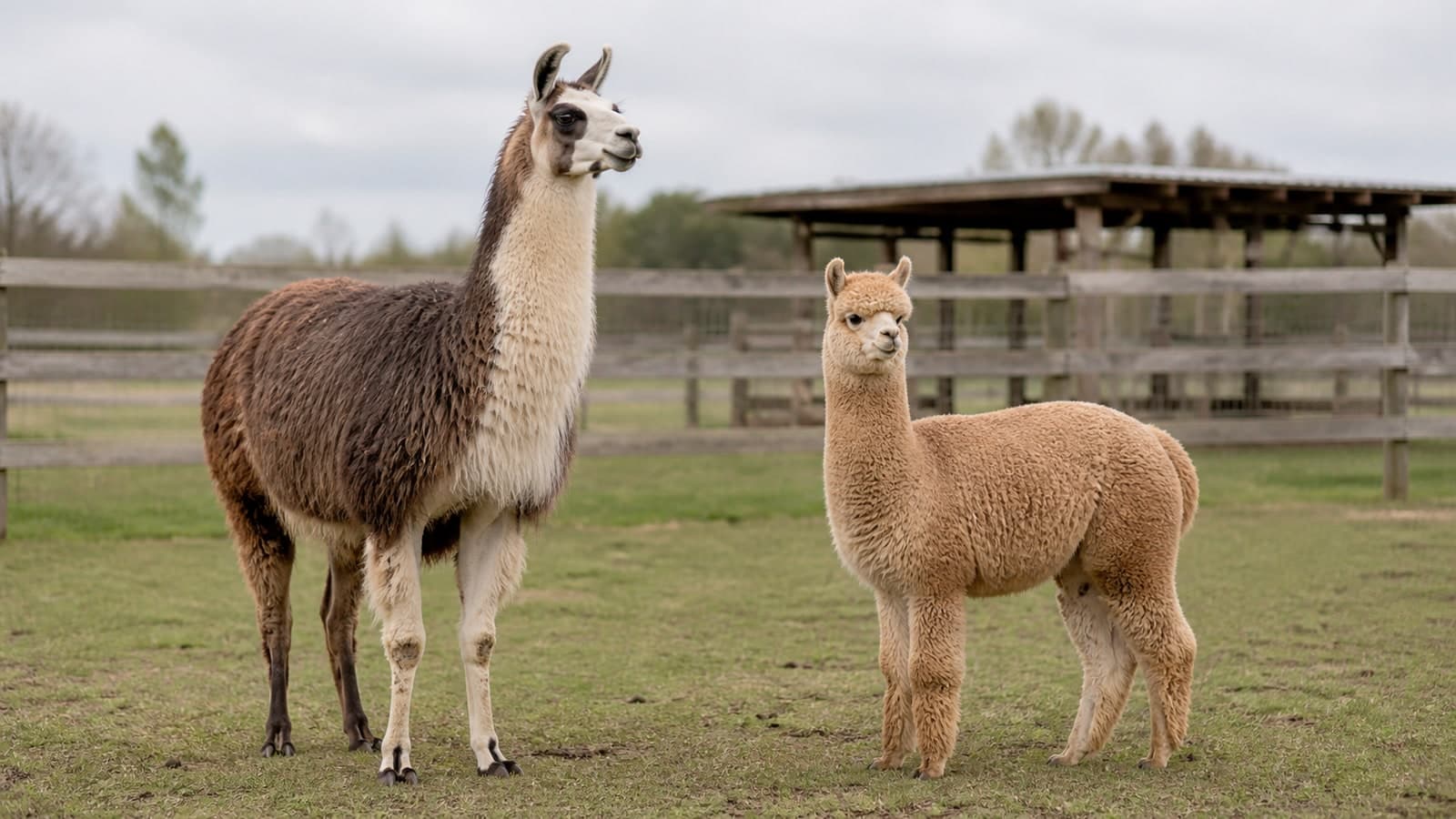
The short answer: a llama is roughly twice the size of an alpaca and was bred to carry things, while an alpaca is smaller and was bred to grow fleece. If you only remember one field test, look at the ears. A llama's are long and curved like a banana. An alpaca's are short and straight, more like a spear tip.
Alpaca vs llama at a glance
These are the typical adult ranges listed in the Merck Veterinary Manual's side-by-side comparison [1].
The two-second test over the fence
Use shape, not size alone. Distance, age and a heavy coat can all make an animal look larger or smaller than it is.
- Ears first. Long and banana-curved means llama. Short and spear-straight means alpaca [1].
- Then the face. A Huacaya alpaca carries fleece down its face and legs, which gives it the blunt, woolly, teddy-bear look [1]. A llama's face reads longer and much less woolly.
- Then the topline. A llama's back is flat. An alpaca's tends to rise a little over the loin, and the tail sits lower [1].
What each animal is for
Alpacas are fibre animals. They are normally shorn once a year. The British Alpaca Society puts a Huacaya at 1 kg or more of skirted fine fibre a year, with a Suri producing roughly double [2]. "Skirted" means after the coarse neck, belly and leg edges are removed, so it is the usable part, not the full shearing-day weight. Fibre diameter varies with age, genetics and the part of the fleece sampled; our guide to alpaca fibre grades explains how to read a test report.
Llamas are pack animals and can work as livestock guardians. Merck puts the upper carrying limit at around 60 kg, while noting that llamas are seldom loaded with more than about 20 kg in practice [1]. Recreational trekking usually asks far less of the animal than carrying freight.
Llama fleece is a different product. The traditional llama coat has a fine undercoat beneath coarser guard hair, although coat types vary widely. International Llama Association material puts guard hair at 0 to 20 percent of the fleece [3]. If the two layers are collected together, the guard hair normally needs to be removed before the softer fibre is spun. That is why a single average micron number never tells the whole story.
Temperament, honestly
Both species can learn to walk calmly on a halter. Llamas are commonly chosen for packing and trekking because of their larger frame, but species alone does not tell you whether an individual will be easy to handle. Ask what training the animal has had and watch it being caught, haltered and led before you buy.
Alpacas are strongly herd-oriented and may be wary of close handling. A lone alpaca is not a sensible shortcut, and neither species should be bought without compatible camelid company.
On spitting: both species do it, and in both it is mostly aimed at other camelids, to settle food squabbles and sort out rank. Camelids reach for flight first and only escalate to the fight response, which includes spitting, when escape is not available [4]. A camelid that spits at people may be frightened, cornered or poorly socialised. Unnecessary bottle-feeding and excessive human contact can create dangerous human-directed behaviour, especially in males [8].
Guard llamas: what the practice really is
A guard llama is a single llama run with sheep or goats, which alarm-calls at canid predators such as foxes and stray dogs and chases them off. The often-quoted numbers come from a 1994 Iowa State University Extension study by Franklin and Powell: around 80 percent of sheep producers rated their llamas effective or very effective, and average flock losses fell from about 11 percent to about 1 percent [5].
Three caveats before you buy one:
- The evidence favours one llama over several. In the Iowa survey, flocks with one guard llama reported lower losses than flocks with multiple llamas. Geldings are commonly chosen because intact males may try to mount ewes, although the study found no difference in guarding effectiveness between gelded and intact males [5].
- Results depend on the farm. A later controlled Utah trial found lower lamb losses in guarded flocks during the first grazing season, but not when losses in the control flocks also dropped. The researchers concluded that predation may need to reach a threshold before an effect becomes visible [6].
- It is one layer of protection. The Iowa producers continued to use other controls alongside their llamas [5]. Good fencing and daily checks still matter.
Which one fits your farm
- Fleece is your main interest and you want the smaller animal. Alpacas. Read the best alpaca breed for beginners next.
- Trekking or packing. Llamas, and budget for training.
- A potential guard for sheep or goats. A carefully selected llama, alongside decent fencing and other controls.
- Nervous about handling. Look for calm, well-socialised geldings and ask how they were raised.
Practical differences matter too. Alpacas are normally shorn annually; llama coat care ranges from brushing or clipping to shearing, depending on the coat [3]. Both need toenail trimming rather than farrier work because camelids have two toes with soft pads, not hooves. Medicine choice and dose belong with your vet and an accurate weight, not an estimate based on species.
About huarizos
A male llama over a female alpaca produces a huarizo, usually intermediate in size and fibre quality [1]. New World camelids have the same chromosome count, and these first-generation crosses can be fertile [1].
Worth taking seriously: alpaca registries can validate pedigrees through DNA testing [7], and a cross is not a purebred alpaca. Keep intact males away from the other species' females unless a planned cross is genuinely your goal.
If you keep both, record the species against each animal from day one. Expected adult weight, coat care and fibre results differ, and treatment records must stay tied to the right animal. AlpacaKeep stores species per animal, and our guide to llama and camelid records covers what to log for each.
Sources & Further Reading
- [1] Merck Veterinary Manual: Overview of Llamas and Alpacas and Comparison of Llamas and Alpacas - weights, withers heights, ear/tail/back shape, Huacaya and Suri coat description, pack capacity and huarizo fertility.
- [2] British Alpaca Society: Fibre & Yarn - annual skirted fibre yield for Huacaya and Suri.
- [3] International Llama Association, Educational Brochure #9: Llama Wool - double coat structure and the 0 to 20 percent guard hair range.
- [4] Rocky Mountain Llama and Alpaca Association: Llama and Alpaca Behavior - flight response before fight response, spitting as part of the fight response.
- [5] Franklin, W. and Powell, K. (1994). Guard Llamas: A part of integrated sheep protection, Iowa State University Extension Pm-1527 - the producer survey, reported losses, single-versus-multiple comparison and practical limits.
- [6] Knowlton, F. and Meadows, L. (2000). Efficacy of guard llamas to reduce canine predation on domestic sheep, Wildlife Society Bulletin 28(3): 614-622 - the controlled Utah trial and the predation-threshold conclusion.
- [7] Alpaca Owners Association: Alpaca Registry and Parent Validation - DNA-based pedigree validation.
- [8] American Association of Small Ruminant Practitioners: Policy Statement Concerning Unnecessary Bottle Feeding of Newborn Camelids - over-socialisation and the risk of dangerous human-directed behaviour.