 AlpacaKeep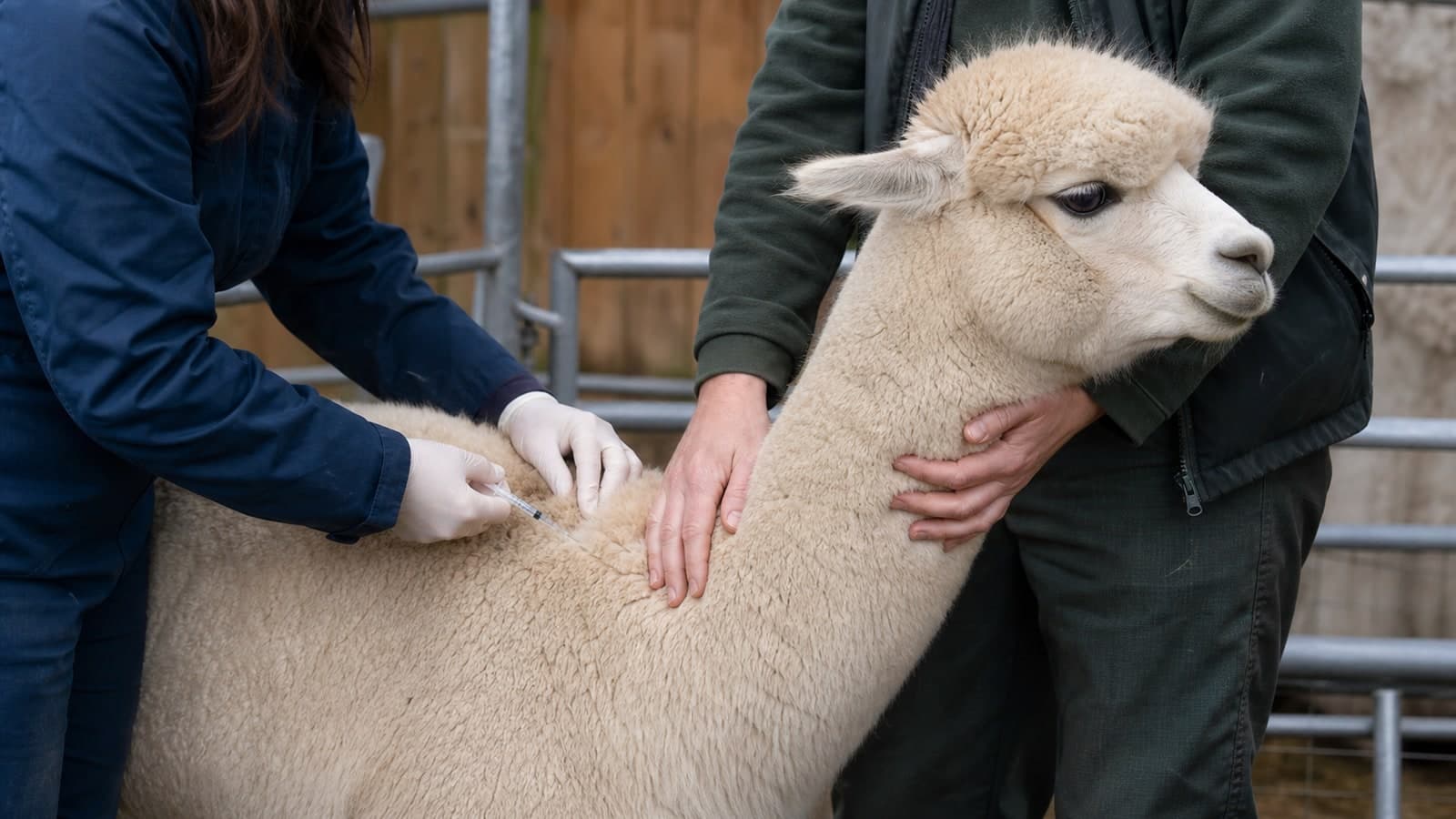
Alpacas are stoic animals. They hide pain right up until the moment they are in serious danger, so by the time a sick alpaca looks sick, you are often already in trouble. That is exactly why a solid alpaca vaccination schedule is the backbone of preventative health. A vaccine builds an invisible shield inside your herd, training the immune system to fight off deadly bacterial toxins before they ever take hold. [1]
There is one quirk that confuses almost every new owner. If you pick up a bottle of clostridial vaccine, you will not see an alpaca on the label. That is because no vaccine is licensed specifically for camelids anywhere in the world. Every alpaca vaccine is borrowed from sheep, goats, or cattle and used "off-label" (also called extra-label) under veterinary guidance. [2] It works well, but it means the schedule below is general guidance, not a substitute for your own vet. Always confirm your farm's exact protocol, product, and dose with your veterinarian.
1. The Core Vaccine: CD&T
The Anchor Rule: Every single alpaca in your herd needs protection against clostridial disease, and the baseline is the CD&T vaccine. [1][2]
Clostridial bacteria are microscopic survivalists. They live naturally in soil, in barnyard dirt, and even in the normal gut of healthy animals. Most of the time they are harmless. But a stressful event, a deep wound, or a sudden carbohydrate overload lets them multiply fast and release lethal toxins. [1]
CD&T protects against three specific, often-fatal threats:
- Clostridium perfringens types C and D cause enterotoxemia, sometimes called overeating disease. When an alpaca breaks into the grain bin or hits a flush of lush pasture, the carbohydrate spike lets these bacteria explode in number, which can kill quickly. [1]
- Clostridium tetani causes tetanus. The spores enter through deep, low-oxygen puncture wounds. A shearing nick, a bite, or a castration site can be enough, leading to muscle spasms and fatal nerve damage. [1]
Do not skip this one because your pastures look clean. In some regions your vet will reach for a broader multivalent clostridial vaccine (a 5-in-1, 7-way, or 8-way) that adds cover for other clostridial species based on local risk. The core principle is the same: clostridial protection is non-negotiable. [2][8]
2. The Alpaca Vaccination Schedule at a Glance
Most of the value in a vaccination program is just consistent timing. Use this as your baseline calendar, then adjust the product and exact dates with your vet.
A quick note for readers outside North America: depending on your country, your vet may use a 5-in-1 or a broader multivalent product (brand names like Lambivac, Bravoxin, or Covexin) rather than a basic 3-way CD&T. These cover extra clostridial species common in your area. [3]
3. Pregnant Dams: The Most Important Timing You Will Set
The Hard Rule: Boost your pregnant females 4 to 6 weeks before their due date. [2]
To see why this window matters, you have to understand how newborn alpacas get an immune system. Unlike humans, alpacas have a placenta that blocks antibodies from crossing during pregnancy. A cria is born with essentially no antibodies of its own. [4]
Instead, the cria relies on passive transfer. The dam packs her disease-fighting antibodies into her colostrum, the thick first milk. When the newborn nurses in those first critical hours, it absorbs those antibodies straight into the bloodstream through the gut wall. (If a cria does not get enough good colostrum in time, it suffers "failure of passive transfer" and is left dangerously exposed, which is one of the most common newborn emergencies. You can read more in our alpaca birthing guide.) [4]
Boosting the dam 4 to 6 weeks before she is due triggers a surge of clostridial and tetanus antibodies right as her body is building colostrum, so the cria's very first drink delivers real protection. [2]
The flip side is timing you must avoid. Do not give a first vaccine course in the first 90 days of pregnancy, and be cautious with multivalent products in early gestation, where they have been linked to pregnancy loss. Avoid vaccinating in the final weeks before birthing too, since handling stress alone can trigger problems in a heavily pregnant dam. [2][4]
4. The Cria Timeline and the Immunity Gap
The Hard Rule: If the dam was properly boosted before birthing, wait until the cria is about 2 to 3 months old (8 to 12 weeks) for its first shot. [2]
The cria immunity gap
Think of a newborn cria's protection as a relay race. For the first leg, the cria runs entirely on antibodies it borrowed from the dam's colostrum. Those borrowed antibodies are strong at birth, but they fade a little more every week. Meanwhile, the cria's own immune system has to pick up the baton and build protection of its own before the borrowed kind runs out.
The tricky moment is the handoff. There is a window where the borrowed protection has dropped low but the cria has not yet built much of its own. That dip is the immunity gap, and the entire point of cria timing is to close it before anything sneaks through.
- Maternal antibodies (the borrowed kind): from the dam’s colostrum, strong at birth, fading a little every week.
- Vaccine antibodies (the built kind): the cria’s own protection, started by the first dose and locked in by the booster.
- The immunity gap: the borrowed kind has faded but the new kind has not caught up yet. The two doses are timed to close it.
Here is the part that surprises almost every new breeder. If you vaccinate too early, while those borrowed antibodies are still high, the dam's antibodies treat the vaccine like an intruder and mop it up before the cria's immune system ever notices it. The shot is simply wasted. So you wait until the borrowed protection starts to fade, at around 8 to 12 weeks, give the first dose, then come back 4 to 6 weeks later for the booster that builds lasting, active immunity. Two doses, timed to land right as the gap opens, and the baton gets passed cleanly. [2]
When the dam was not vaccinated
The rules flip completely for a cria from an unvaccinated dam, or one whose history you do not know. That cria never got a strong first leg of the relay, so it has little or no borrowed protection to begin with. Waiting two months would leave it exposed the entire time. Work with your vet to start protection much earlier, as soon as it is safe for a healthy, unstressed cria. This is exactly the kind of judgment call where the off-label, "ask your vet" rule matters most. [2][4]
5. Adults and the Booster You Cannot Skip
For an adult that has never been vaccinated, a single shot does not create lasting immunity. Think of the first dose as an introduction: it simply shows the threat to the immune system, which takes a look, deals with it, and largely forgets it. The second dose, given 3 to 6 weeks later, is the one that builds long-term memory. [2][5]
After that primary course, a single annual booster maintains protection. In the UK alpaca survey, more than 75 percent of holdings administered annual boosters, with a smaller group dosing every six months in higher-risk setups. [3] If you give a weanling its first CD&T and forget to bring it back for the booster a few weeks later, it is not actually protected. Finish the series, every time.
6. Regional and Non-Core Vaccines
The Hard Rule: Only add a non-core vaccine when a specific disease is a real risk in your area. Do not over-vaccinate. [2]
Because every camelid vaccine is off-label, putting unnecessary products into your herd adds injection-site reactions and cost without a clear payoff. There is no validated, one-size-fits-all camelid schedule in any country, which is why every credible source lands on the same advice: build a risk-based plan with your vet. [2][3]
A note for continental Europe
If you farm in Germany, Italy, or elsewhere on the continent, the core does not change: an annual clostridial-and-tetanus vaccine, given off-label under your vet. German camelid guidance, for example, treats annual clostridial cover as standard and starts crias on the same first-dose-and-booster pattern, all as a deliberate off-label use (in German, Umwidmung). [7] The real differences are which product your vet can source (the same sheep and cattle multivalents sold across Europe, like Covexin or Bravoxin) and the paperwork. In Italy, for instance, any holding that keeps camelids has to be entered in the national livestock registry (BDN), so tidy, per-animal vaccination records are not just good husbandry, they line up with what the authorities already expect. [9]
Rabies
This is the clearest regional fork. In rabies-endemic areas such as much of the United States, where raccoons, skunks, foxes, and bats carry the virus, vets commonly recommend an annual off-label rabies vaccine for camelids. [1][6] In rabies-free regions, including the UK, Ireland, Italy, and Germany, it is not part of routine care. [1] One caveat for continental Europe: terrestrial rabies has been eliminated, but bat lyssaviruses still circulate, so "rabies-free" does not mean zero risk. Check your national rules.
Mosquito-borne disease
In regions with heavy mosquito pressure, West Nile Virus can cause fatal neurological disease, and some farms in high-risk zones use equine vaccines off-label ahead of the mosquito season. Talk to your vet about whether your local burden justifies it. [2]
What not to reach for
Some products are deliberately left off the list. There is no camelid-approved BVDV vaccine, and routine BVDV vaccination is not currently recommended: the accepted control approach is to find and remove persistently infected animals, not to vaccinate the herd. Leptospirosis vaccine is generally reserved for farms with a confirmed local problem. When in doubt, less is more. [2]
7. Dosing and Administration: The Mistakes to Avoid
The cattle-dose trap
When you buy a clostridial product, the label is usually written for cattle, and it will often quote a large dose such as 5 ml. Do not give your alpaca the cattle dose. [2] The standing rule for off-label camelid medicine is to use the sheep (small-ruminant) dose unless your vet tells you otherwise. Depending on the product, that is often in the region of 1 to 2 ml, but it genuinely varies by brand, so read the label and confirm with your vet rather than guessing. A grossly oversized dose mainly risks a painful, lasting lump or abscess at the injection site. [3]
Subcutaneous, not intramuscular
Clostridial vaccines are designed to go just under the skin (subcutaneous), not deep into the muscle. The easiest site is the loose skin at the base of the neck, in front of the shoulder. Use a short needle (6 mm), tent the skin, and inject underneath. Going into the muscle increases pain and swelling and can make the vaccine take up more slowly and unevenly. [4]
One syringe, one product
If you are giving more than one injection on the same day, never mix different products in a single syringe, and give them at separate, clearly different sites. The point is not that they "cancel out," it is that if a reaction develops you want to know which shot caused it. Rotating and recording injection sites also helps you spot the skin thickening that off-label products sometimes leave behind. [3]
Keep Your Vaccinations Off the Whiteboard
The hardest part of vaccination is not the needle, it is the tracking. Remembering which cria turns eight weeks old next, when each dam enters her pre-birthing window, and which adults are due for an annual booster quickly turns into a pile of whiteboard notes and half-remembered dates. Miss one booster and an animal is quietly unprotected.
This is exactly what we are building AlpacaKeep to handle. You set up your vaccination routines once, and each due date shows up as a task on your dashboard - including annual boosters, which repeat as soon as you tick the last one off. You can store your exact off-label products and doses in a medication library and track meat and milk withdrawal periods per animal, so the record is always there when a buyer or vet asks.
We are not live yet, but you can lock in your spot. Join the AlpacaKeep early-access list In the meantime our free record-keeping templates include a medication log you can print today, with no signup. Stop relying on memory and start protecting your herd on a schedule.
Sources & Further Reading
- [1] Merck Veterinary Manual: Herd Health of Llamas and Alpacas
- [2] Veterian Key: Camelid Vaccinations (camelid medicine textbook chapter)
- [3] Middleton et al. (2024), Veterinary Record: Survey of current UK alpaca husbandry practices: vaccination, treatment and supplementation (DOI 10.1002/vetr.3602)
- [4] Veterian Key: Disorders and Diseases of Pregnancy (camelid) and Merck Veterinary Manual: Reproduction of Llamas and Alpacas
- [5] Merck Veterinary Manual: Clostridial Vaccines for Animals
- [6] Bedenice et al. (2016), JAVMA: Antibody response to a commercial rabies vaccine in alpacas (extra-label use)
- [7] AZVD (German alpaca and llama health resource, azvd.de): camelid health and vaccination guidance
- [8] Australian Alpaca Association: Five-in-one (clostridial) Vaccination Protocol
- [9] Italian Ministry of Health: Anagrafe Zootecnica (national livestock registry / BDN), camelid registration requirement