 AlpacaKeep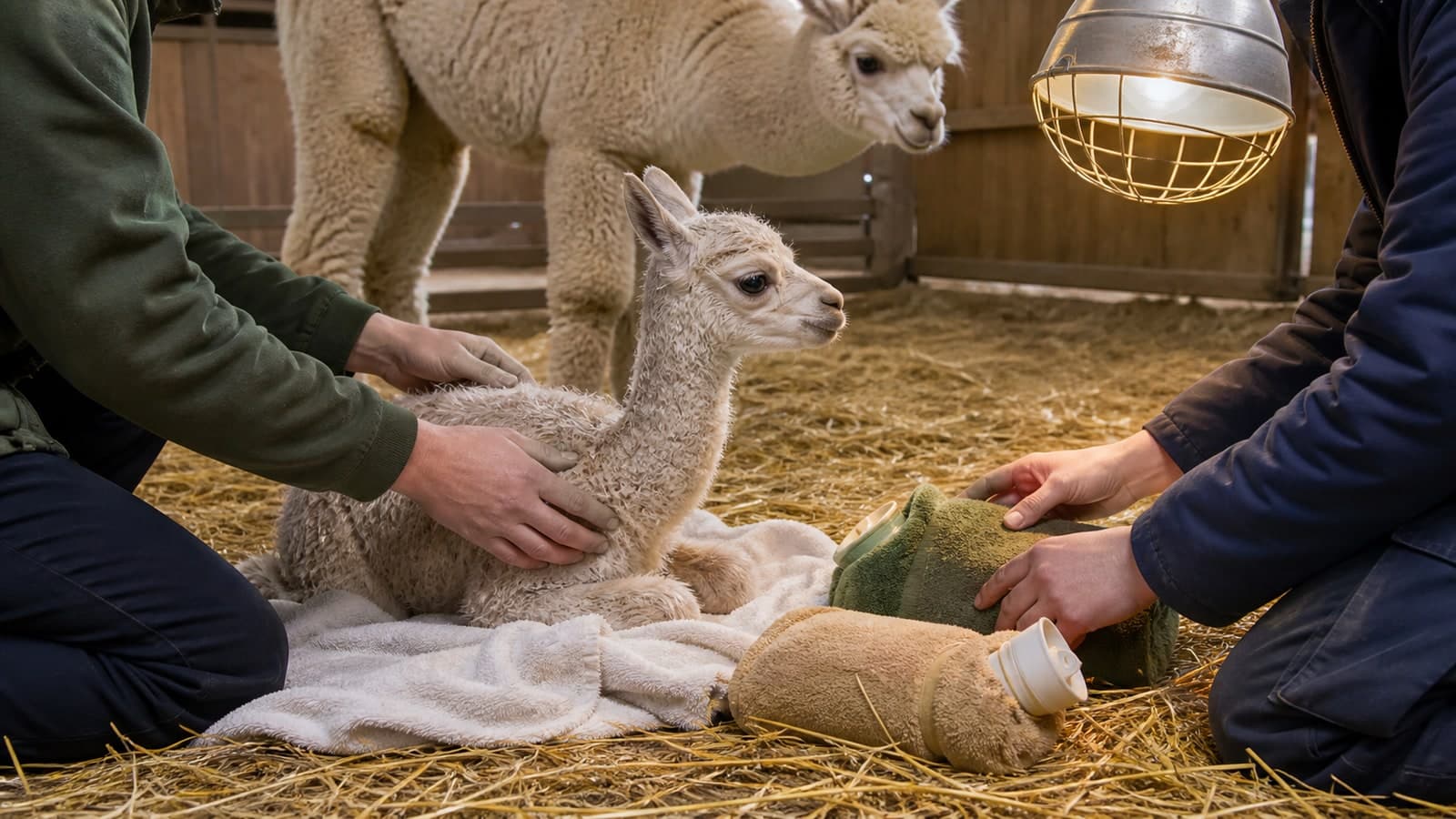
Most crias stand within 45 minutes, nurse within an hour, and never see a vet all week. When one does not, the clock is short. Alpacas are prey animals, so a weak cria hides its decline: it stays lying down, its ears droop, it stops nosing at the udder, and by the time it looks obviously sick you have already lost hours.
This guide is a triage reference for the five newborn cria emergencies, plus limb problems that owners routinely get wrong. The steps below are first aid to stabilize a cria while you are on the phone to your vet, not a substitute for the vet. For what a normal birth and a normal first hour look like, read Alpaca Birthing: What's Normal, What's Not, When to Call the Vet first.
1. Hypothermia: Warm First, Feed Second
A healthy cria's body temperature sits close to 37.8 °C in the first hour. A wet cria born onto cold ground loses heat fast, and a small or premature cria loses it faster still. Below roughly 37.5 °C the cria's gut essentially stops moving. Below 37 °C the cria is genuinely cold, and below 36 °C you are looking at severe hypothermia.
The cardinal rule: never feed milk or colostrum to a cold cria. In a hypothermic cria, the first stomach (C1) has no motility. Colostrum poured in sits, ferments, gasses up and bloats the cria. That bloat can kill faster than the cold does. It is the single most common preventable death in the first 24 hours.
Warm the cria first:
- Dry it aggressively with clean towels. Wet fibre is a heat sink.
- Get it out of the wind into a warm barn, shed or the house.
- Wrap warm water bottles (around 40 to 45 °C, not hot) in a towel and tuck them along the flanks.
- Use a heat lamp cautiously, high enough that the cria cannot burn itself.
- Cria coat or blankets once dry.
Take rectal temperature every 15 to 20 minutes. Only once the cria is back above 37.8 °C and holding do you offer warm colostrum. If the temperature is not rising within 30 minutes, call your vet: severe hypothermia usually needs warmed intravenous fluids.
2. Weak Suckle, Failed Nursing and Safe Assisted Feeding
If your cria is still lying down at 60 minutes, or standing but not searching for the udder by 90 minutes, intervene. Check three things in order:
- Warmth first. A cold cria will not suckle. Confirm temperature above 37.8 °C before you spend an hour trying to bottle-feed.
- The suckle reflex. Slide a clean finger into the corner of the cria's mouth. A healthy cria clamps down and pulls rhythmically within a second or two. No reflex at all is a vet call, now.
- Cleft palate. Open the mouth and look for a visible split running front to back in the roof. A cria with a cleft palate will aspirate anything you bottle-feed. Vet call before you offer any milk.
If the reflex is present but the cria will not latch, the usual problem is a first-time dam with a tight udder or teats too large for a small mouth. Milk the dam by hand: 30 to 60 mL of colostrum usually comes off easily. Offer it by bottle, not syringe.
Bottle posture matters. Feed the cria upright and sternal, cushed on its brisket the way it would nurse from the dam, head level and neck extended. Never feed a cria flat or with the head tipped back. In the correct posture the oesophageal groove reflex routes milk past C1 and C2 directly into C3, the true stomach. Fed flat, or in big boluses, milk spills into C1 where it ferments.
Volume target: 10 to 15 percent of body weight in colostrum over the first 12 to 24 hours, split into feeds every 2 hours and front-loaded while the absorption window is open. A 7 kg cria therefore needs roughly 700 to 1050 mL in its first day. Use a lamb bottle with a small teat: milk should flow one drop at a time when you invert it, or you will cause aspiration.
Tube feeding: only when the suckle reflex is absent
If the cria has no suckle reflex, bottle feeding will send colostrum into the airway. Tube feeding delivers it directly to the stomach and is genuinely lifesaving in the right hands. It is also the fastest way to kill a cria if you put the tube into the trachea. The first time you tube a cria, do it under vet guidance, in person or on a video call, not from a text article.
Technique in outline:
- Use a soft red rubber catheter, 14 to 18 French. Human infant tubes are too fine and knot in the throat.
- Pre-measure the tube along the outside of the cria from the nose to the point of the 9th rib. Mark that distance with tape. That is how far in it goes.
- Confirm placement. With the cria cushed and sternal, pass the tube down the left side of the mouth. Place the free end in a cup of water: bubbles synchronised with breathing mean the trachea, pull out and start again. No bubbles plus palpating two tubes in the neck means you are in the oesophagus.
- Gravity flow, never pressure. Attach a 60 mL syringe barrel with the plunger removed and let warm colostrum run in.
- Withdraw with the tube kinked closed so you do not drip fluid into the airway.
3. Meconium Impaction
Meconium is the tar-black, sticky first stool the cria carries in its rectum at birth. A healthy cria passes it within 12 to 18 hours. Signs of impaction:
- Straining and arched back, often with tail flagging.
- Restless sit-stand cycling, cushing then getting up then cushing again.
- Reduced or absent nursing because the cria is uncomfortable.
- Bloated abdomen in the more advanced cases.
Do not use a Fleet enema, or any product containing sodium phosphate. Sodium-phosphate enemas are sold for humans and marketed as safe, but phosphate is absorbed through the rectal wall directly into the bloodstream. In human infants they have caused fatal hyperphosphataemia and matching calcium crashes, and the same physiology applies to a 7 kg cria. Every camelid neonatal reference warns against them.
Safe first-aid options:
- 20 to 30 mL of warm soapy water with a mild pure soap like castile.
- 10 to 20 mL of warm mineral oil, often gentler and effective where soapy water is not.
- A soft 10 to 14 French catheter, thoroughly lubricated, inserted no more than 5 to 7 cm. Never force against resistance: you will tear the rectal wall.
Cush the cria, lift the tail, and let fluid run in by gravity. Then let the cria walk. Most pass meconium within 10 to 30 minutes. If one gentle enema does not resolve it, or the cria is progressively more bloated and depressed, that is a vet call.
4. Failure of Passive Transfer (FPT)
Alpacas and llamas have a diffuse epitheliochorial placenta. In plain terms, the placental layers block antibody transfer from the dam's bloodstream in the womb, so crias are born with essentially no immunoglobulins. Every antibody the cria uses for its first weeks of life has to be absorbed from colostrum.
The window is short. Absorption is greatest in the first 6 to 12 hours, much reduced by 18 hours, and effectively closed by 24. A cria that misses the window will not catch up by drinking more the next day: the gut has closed.
Definition of failure of passive transfer: a serum IgG below 1000 mg/dL at 24 to 48 hours of age is defined as FPT (Weaver et al. 2000; Merck Veterinary Manual). Some vets grade values below 500 mg/dL as severe FPT because the risk of septicaemia rises steeply below that mark. Test any cria that did not nurse promptly, was premature or dystocia-born, or came from a dam with poor-quality colostrum, regardless of how well it looks. The test is a simple blood draw run in-clinic; results are back in 10 minutes.
Treatment after gut closure is a camelid plasma transfusion, given intravenously by your vet. Oral colostrum no longer transfers antibodies into the bloodstream once the gut has closed, so bottle-feeding more is useless. Plasma from a donor camelid or a camelid plasma bank bypasses the gut and delivers antibodies directly. Volume is calculated from body weight and starting IgG; this is vet-only because of transfusion reaction risk.
Prevention beats treatment: verify the cria has actively nursed within 2 hours, hand-milk and bottle-feed colostrum if there is any doubt, and book the IgG test rather than guessing.
5. Prematurity and Dysmaturity
See Cria Growth Curve: Birth Weight, Daily Gain and When to Worry for the term birth-weight distribution and normal daily gain.
A premature cria is one born early. A dysmature cria is one born at term but underdeveloped, usually because of placental insufficiency or a twin pregnancy. Both look the same clinically and both need the same emergency response.
Markers of prematurity or dysmaturity:
- Birth weight under about 6 kg.
- Floppy, drooping ears that will not stand up. Term crias have ears that spring upright within an hour.
- Unerupted incisors. A term cria has visible lower incisors at birth.
- Extreme tendon laxity, walking flat on the back of the pasterns.
- Short, silky fleece rather than crimped or curly cover. The fibre coat matures late in gestation.
- Laboured breathing or a rapid breathing rate above 60 per minute at rest. Lung surfactant is one of the last things to develop.
- Poor thermoregulation. These crias go hypothermic in a warm barn.
These crias need a vet on-site the same day: warmed IV fluids, sometimes oxygen support, often plasma. Do not wait to see whether it perks up. Warm the cria, do not feed until it is warm and swallowing, and ring the vet while you are drying it off.
6. Limb Problems: Laxity Versus Contracture
Two limb problems commonly show up in the first days of life, and they need opposite treatments. Getting them the wrong way round makes both worse.
Tendon laxity, sometimes called dropped pasterns, is a cria walking with the fetlocks and pasterns collapsed close to the ground rather than upright over the toe. Common in premature or dysmature crias, and also in term crias born on deep bedding.
- Treatment: firm footing (dry short grass or non-slip rubber), moderate exercise, and no splinting. Splints weaken the tendon further because they take the load off.
- Timing: most cases resolve on their own within 3 to 7 days.
Tendon contracture is the opposite pattern: the cria stands knuckled forward at the fetlock, unable to straighten the leg, or walks on the tips of its toes. It happens when tendons developed shorter than the growing bone in late gestation.
- Treatment: gentle daily stretching by hand, and in more severe cases padded splints applied by your vet.
- Get the vet involved early, because a splint applied wrong causes pressure sores in a day.
If you are not sure which pattern you are seeing, photograph the cria standing and send it to your vet.
The Call-the-Vet-Now Cheat Sheet
If any single line here is true, call your vet now. This list assumes the birth itself is done: see the birthing guide for labor thresholds.
- Cria rectal temperature below 37 °C, or not rising after 30 minutes of warming.
- Cria will not swallow, or has no suckle reflex.
- Cleft palate visible in the roof of the mouth.
- No meconium passed by 18 hours, or an enema has not resolved the impaction on the first gentle attempt.
- Cria has not actively nursed by 2 hours, even after milking the dam and bottle-offering colostrum.
- Serum IgG at 24 to 48 hours below 1000 mg/dL, or a farm history that flags FPT risk.
- Cria under 6 kg at birth, or showing floppy ears, unerupted incisors, laboured breathing or extreme tendon laxity.
- Cria progressively bloated, depressed, or refusing to stand more than an hour after previously standing.
- Cria knuckling forward at the fetlock rather than standing flat over the toe.
- Any cria that "just does not look right" to an experienced eye. Prey-animal decline is silent, and your gut is usually correct.
Stop Guessing With Spreadsheets
The thresholds above are simple in theory and brutal in practice. At 3am, with a first-time dam and a cria that stood for 20 minutes and then lay back down, you do not want to be flipping through a PDF looking up what temperature is too cold or how long you have before the colostrum window closes.
This is exactly why we built AlpacaKeep: you record each birth with its time, birth weight, whether it was assisted and any complications, then log the cria's weights and see on the chart in its profile whether it is gaining.
AlpacaKeep is built and run on a working alpaca farm and is in private beta now for farms in the EU, the UK, Australia and New Zealand, with every feature free for the beta farms. The Free plan for up to 10 animals stays free afterwards. Get early access. Our free record-keeping templates are yours to download too, with no signup.
If you are still counting down to a first birth, run your mating date through the Free Alpaca Gestation Calculator and pair it with When Should 'Cria Watch' Actually Begin? so you know when to move the dam to the birthing paddock.
Sources & Further Reading
- [1] Cebra C, Anderson DE, Tibary A, Van Saun RJ, Johnson LW (2014). Llama and Alpaca Care: Medicine, Surgery, Reproduction, Nutrition, and Herd Health. Elsevier Saunders. Neonatal warming protocols, tube-feeding technique, oesophageal groove reflex, safe enema volumes.
- [2] Whitehead CE (2009). Management of neonatal llamas and alpacas. Veterinary Clinics of North America: Food Animal Practice, 25(2), 353 to 366. Colostrum volume targets, bottle posture, first-hour clinical checks.
- [3] Whitehead CE (2009). Neonatal diseases in llamas and alpacas. Veterinary Clinics of North America: Food Animal Practice, 25(2), 367 to 384. Hypothermia thresholds, meconium impaction management, warning against sodium-phosphate enemas.
- [4] Weaver DM, Tyler JW, Marion RS, Wallace LM, Nagy JK, Holle JM (2000). Evaluation of assays for determination of passive transfer status in neonatal llamas and alpacas. Journal of the American Veterinary Medical Association, 216(4), 559 to 563. IgG assay methodology and the 1000 mg/dL FPT threshold.
- [5] Weaver DM, Tyler JW, Marion RS, et al. (2000). Passive transfer of colostral immunoglobulins in neonatal llamas and alpacas. American Journal of Veterinary Research, 61(7), 738 to 741. Colostrum absorption window, gut closure timing.
- [6] Merck Veterinary Manual: Parameters for Newborn Llamas and Alpacas and Failure of Transfer of Passive Immunity in Large Animals. Term birth weight, first-hour vital signs, IgG target values, plasma transfusion as the post-closure treatment for FPT.