 AlpacaKeep
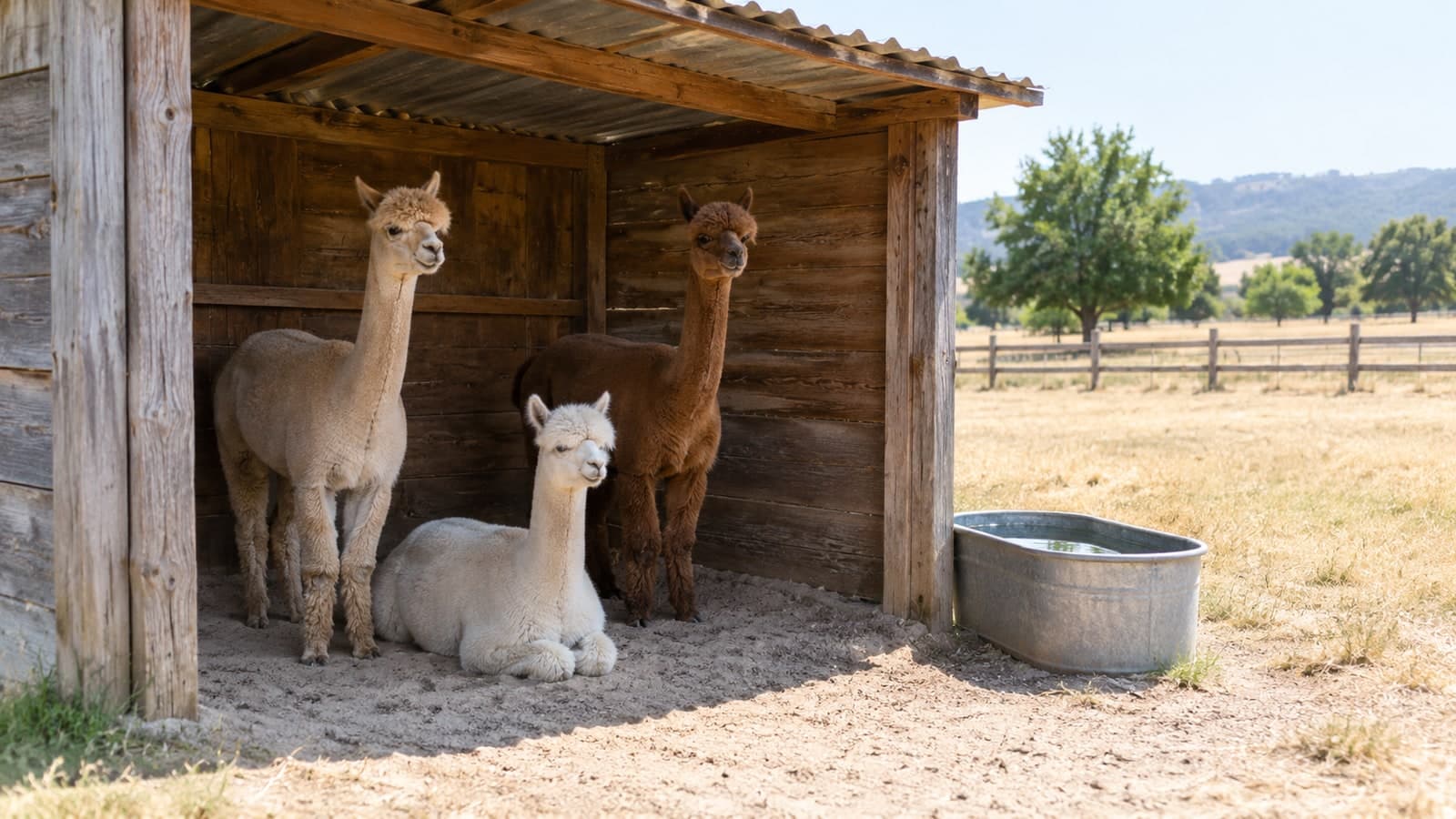
Alpacas cope with summer heat less well than many keepers expect. The two big reasons are their fleece and humid air: a thick coat holds heat in, and humidity takes away much of an alpaca's ability to cool down. Heat stress is an emergency, so it pays to know the signs and to keep your herd cool before it starts.
If an alpaca breathes through its mouth, seems weak or will not get up on a hot day, call your vet now. While you wait, move it into shade and moving air, cool its legs and belly with a gentle hose and give no medicines unless your vet says so.
This guide is a plain-language summary, not veterinary advice: your vet decides treatment.
Alpaca temperature tolerance: why heat is hard for them
Alpacas and llamas can handle winters as low as -10 °C with reasonable wind shelter. Heat is another matter. Their coat is made for cooler climates, so hot, humid weather far from their original home can make them overheat.
Thermal windows: the cooling spots
An alpaca sheds heat mainly through its thermal windows: the belly, the armpits and the inside of the thighs, where hair is shorter and skin thinner. These areas make up about 20% of the skin. Alpacas also have sweat glands, concentrated in these same patches of skin. By changing their posture, they open these areas to the air or close them off, depending on the weather.
Why humidity makes it worse
On a hot, humid day, the usual ways of losing heat, to the air and to the ground, stop working. An unshorn alpaca is left with only its breathing and sweating, and that may not be enough. So humid heat is more dangerous than the thermometer alone suggests.
Normal alpaca temperature and when it is too high
For adult llamas and alpacas, the Merck Veterinary Manual's table of vital signs and an Austrian keeping handbook, written with vets from the Vienna veterinary university, both give 37.5 to 38.9 °C, taken in the rectum. Healthy alpacas also run cooler in the morning and warmer later in the day, so one reading means little without watching how the animal behaves.
How to take the temperature
Take it in the rectum. Hold the animal still, put a lubricated thermometer into the anus and keep its tip against the wall of the rectum. A reading above the normal range can also mean an infection, so always look at the whole animal, not just the number.
Normal breathing
At rest, an adult alpaca or llama breathes about 10 to 30 times a minute, and young animals sit at the top of that range. To count, watch the chest for 15 seconds and multiply by 4. Breathing also speeds up with heat, effort, pain or stress, so a fast rate on a hot day tells you to look closer. No source gives a single rate that means heat stress. The warning sign the Merck Veterinary Manual and the Austrian handbook name is breathing through the open mouth, because camelids normally breathe only through the nose.
When a reading is too high
The Merck Veterinary Manual describes body temperature in heat stress as above 38.9 °C and as high as 41.7 °C. A Texas veterinary hospital treated 15 llamas and alpacas for heat stress. For the animals whose owners took a temperature on the day they noticed the illness, half read 41.8 °C or more.
There is no single reading at which heat stress "starts". A reading above the normal range on a hot day, together with any of the signs below, means you should call your vet now. A normal reading does not rule it out either: animals have often cooled down again by the time they reach the clinic.
Signs of heat stress in alpacas
Watch for these early signs:
- eating less
- reluctance to get up
- not being able to kush (lie down in the normal resting position, legs folded under the body)
- dullness and weakness that gets worse, sometimes more in the front legs
Other signs of heat stress:
- fast breathing and open-mouth breathing
- shaking
- foaming at the mouth
- little or no urine
- collapse and coma
Open-mouth breathing means the alpaca is already in serious trouble. Males often have a swollen scrotum: it is the body trying to shed heat. Many cases are already advanced by the time anyone notices, so on hot days check your herd more often.
First aid while you wait for the vet
If you see the signs above on a hot day, call your vet now. Then, while you wait:
- Move the animal into shade and moving air, such as a fan.
- Cool the belly and legs with a gentle hose. Do not soak the fleece of an unshorn animal.
- Keep fresh water within reach.
- Give no medicines unless your vet tells you to.
- Cool, but do not aim for a normal reading. Cooling an animal all the way back to normal can overcool it, so your vet decides how far to go.
When your vet arrives, in a mild case they may clip the fibre on the belly and inner legs and cool the animal.
Why the vet visit still matters if it looks better
Without treatment, heat stress can damage the organs, and many animals that seem to get better at first still die one to three days later. Spotting it early and getting your vet to treat it quickly make the difference. In the Texas hospital, more than half of the severe cases did not survive. Of the seven that went home, two could not control their body temperature normally for a while afterwards; one took 40 days.
Who is most at risk
For crias, the warning signs and normal temperatures are in our newborn cria emergencies guide.
Heat and pregnancy
The Merck Veterinary Manual lists heat stress among the causes of abortion in llamas and alpacas. In cattle, heat is known to harm early pregnancy; in camelids vets suspect the same, but it has not been shown, and no veterinary source we found says which stage of pregnancy is most at risk. Keeping pregnant females shorn, shaded and well watered is the safe course.
Heat and fertility in breeding males
Heat stress affects fertility in both males and females. The clearest figures come from a German study of llamas, not alpacas: males kept at 29 °C day and night for four weeks saw their sperm count fall from 97.5 to 10 million per ml. Sperm production recovered within six weeks.
That was a month of non-stop heat, not one hot afternoon. Still, it is a good reason to keep breeding males shorn and shaded, and shearing may help the fertility of males that have suffered heat stress.
How to keep alpacas cool in summer
Shear before summer
Shearing helps, and several studies show it. The Austrian handbook is clear: alpacas must be shorn every year to avoid serious heat stress in summer. In one US trial, the average temperature of the unshorn alpacas went above the normal range five times, against once for the shorn group. If a full shear is not possible, clipping the barrel (the trunk) is an acceptable way to prevent heat stress, though a full shear is better. For the timing, see when to shear alpacas.
Shade, airflow and bedding
- Shade with ventilation. A shelter with shade, ventilation and wind protection is a must for camelids. Make the openings wide enough that young, old or thin animals can get in without being pushed away.
- Fans. Fans help by keeping the air moving.
- No straw in summer. Straw bedding covers the thin skin of the belly, one of the cooling spots described above. Use sand, concrete or shaded pasture with fans or misters instead.
Water, hoses and pools
- Fresh water at all times. Swiss law requires it for llamas and alpacas. For how much they drink, see what do alpacas eat.
- Hose the legs and belly, not the back. A gentle spray from a garden hose on the legs and belly helps. Never soak an unshorn animal: the wet fibre traps the water and holds the heat in.
- Pools, but not where a cria may be born. Deep pools help with cooling. If you have heavily pregnant females, though, take the pools away: a cria born into one can drown in very shallow water.
Vet work and handling in the cool of the day
Plan outdoor procedures, such as treatments under sedation, for cooler times of day with shade nearby. Never leave a sedated animal alone outdoors.
The rules by country
Few of these rules name alpacas, and most ask in general terms for protection from bad weather. Here is what the texts say; your local animal-health authority has the final word on what applies to you.
United Kingdom
In England and Wales, the Animal Welfare Act 2006 makes it an offence not to take reasonable steps to meet an animal's needs, including a suitable environment. The farm animal rules for England add protection from bad weather outside, "where necessary and possible". We did not check the rules for Scotland, Wales or Northern Ireland.
European Union
The farm animal directive (98/58/EC) asks for protection from bad weather for animals kept outside, "where necessary and possible", and a suitable water supply.
Germany
No rule names alpacas. For animals kept "zu Erwerbszwecken" (as a business), § 3 of the farm animal welfare ordinance (Tierschutz-Nutztierhaltungsverordnung) asks for housing that gives enough protection from bad weather, "soweit für den Erhalt der Gesundheit erforderlich" (where needed to keep the animals healthy). For every keeper, business or hobby, § 2 of the Tierschutzgesetz says an animal must be kept in line with its species and needs. Whether a hobby herd counts as a business is a question for your Veterinäramt.
Austria
Austria's keeping rules are the only ones here that name heat for camelids. Your animals need a stable or field shelter (Unterstand) that protects all of them at once. Animals out on pasture for a while without direct access to one need natural cover, such as rock overhangs or groups of trees, or must be moved to an enclosure with a shelter in harmful heat or wet.
Switzerland
Animals kept outside need protection from wet, wind and strong sun, for all of them at once. Switzerland is also the only country here with a legal shearing duty: llamas and alpacas must be shorn according to their hair growth and condition. The Federal Food Safety and Veterinary Office (FSVO) explains why: so the fleece does not mat and heat does not build up underneath.
Italy
No national rule names alpacas. D.Lgs. 146/2001, Italy's version of the EU directive, covers animals kept for wool or other farming purposes and asks for shelter from bad weather outside, as needed and as possible. We did not check regional rules, so ask your ASL what applies to your herd.
United States
The federal Animal Welfare Act leaves out farm animals kept for food or fibre, so for a working fibre herd it is mostly state law that counts, and state laws differ. The Act's regulations name llamas as farm animals but not alpacas. Animals kept as pets or shown to paying visitors come under a different part of the Act, so if you offer paid walks or visits, ask USDA APHIS whether it covers you. For everything else, your state veterinarian or state department of agriculture can tell you what applies to your herd.
Australia
Animal welfare is state and territory law. New South Wales asks for proper and sufficient food, drink and shelter, as far as is reasonably practicable, and Victoria asks the same for animals that are confined or cannot provide for themselves. Queensland sets a duty of care that includes appropriate accommodation or living conditions. We found no farm code of practice for alpacas or llamas in those three states or in the national standards.
In Australia, the one rule we found that names heat for alpacas is for transport. The national land transport standards say that alpacas under 12 months old, or less than 10 days off shears, need a vehicle with an enclosed front or other protection in weather that could cause heat or cold stress or sunburn. These standards are a mandatory code in the ACT; we did not check how each other state adopts them, so ask your state department of primary industries or agriculture.
Keep a record of hot days
In AlpacaKeep you can log a health event on each animal's record, with the date, a note and any treatment your vet gives, so the whole history is in one place.
AlpacaKeep is built and run on a working alpaca farm and is in private beta now for farms in the EU, the UK, Australia and New Zealand, with every feature free for the beta farms. The Free plan for up to 10 animals stays free afterwards. Get early access.
Sources & Further Reading
- [1] Wiedner E. Merck Veterinary Manual: Diseases of Llamas and Alpacas, Management of Llamas and Alpacas and Herd Health of Llamas and Alpacas.
- [2] Norton PL et al. (2014). Camelid heat stress: 15 cases (2003-2011). Canadian Veterinary Journal 55(10), 992 to 996.
- [3] Jones M, Boileau M (2009). Camelid Herd Health. Veterinary Clinics of North America: Food Animal Practice 25(2), 239 to 263.
- [4] Gerken M (2010). Relationships between integumental characteristics and thermoregulation in South American camelids. Animal 4(9), 1451 to 1459.
- [5] Navarre CB et al. (2001). A comparison of physical examination and clinicopathologic parameters between sheared and nonsheared alpacas (Lama pacos). Small Ruminant Research 39(1), 11 to 17.
- [6] Schwalm A et al. (2007). Changes in testicular histology and sperm quality in llamas (Lama glama), following exposure to high ambient temperature. Theriogenology 67(8), 1316 to 1323.
- [7] Mattiello S, Formis E, Barbieri S (2011). Thermoregulation of alpacas bred in Italy. International Journal of Biometeorology 55(2), 213 to 218.
- [8] Moore KE, Maloney SK, Blache D (2015). High follicle density does not decrease sweat gland density in Huacaya alpacas. Journal of Thermal Biology 47, 1 to 6.
- [9] Fowler ME (1994). Hyperthermia in llamas and alpacas. Veterinary Clinics of North America: Food Animal Practice 10(2), 309 to 317.
- [10] LFI Österreich. Neuweltkamele: Alpakas und Lamas in Österreich (2020).
- [11] Alpaca Owners Association. Heat Stress in Alpacas.
- [12] Rocky Mountain Llama and Alpaca Association. Heat Stress in Llamas and Alpacas (2023).
- [13] UK: Animal Welfare Act 2006, section 9 and Welfare of Farmed Animals (England) Regulations 2007, Schedule 1.
- [14] EU: Council Directive 98/58/EC.
- [15] Germany: Tierschutz-Nutztierhaltungsverordnung and Tierschutzgesetz § 2.
- [16] Austria: 1. Tierhaltungsverordnung, Anlage 11.
- [17] Switzerland: Tierschutzverordnung (SR 455.1), Verordnung des BLV über die Haltung von Nutztieren und Haustieren (SR 455.110.1), and BLV Fachinformation 17.1.
- [18] Italy: D.Lgs. 26 marzo 2001, n. 146.
- [19] USA: 7 U.S.C. § 2132 and 9 CFR § 1.1.
- [20] Australia: Prevention of Cruelty to Animals Act 1979 (NSW), Prevention of Cruelty to Animals Act 1986 (Vic), Animal Care and Protection Act 2001 (Qld), and Australian Animal Welfare Standards and Guidelines: Land Transport of Livestock, Part B1.
- [21] Pearson LK, Rodriguez JS, Tibary A (2014). Disorders and Diseases of Pregnancy. In: Cebra C et al. (eds), Llama and Alpaca Care. Elsevier.
- [22] NADIS, Potter T. The Healthy Alpaca.
- [23] Merck Veterinary Manual: Abortion in Camelids.