 AlpacaKeep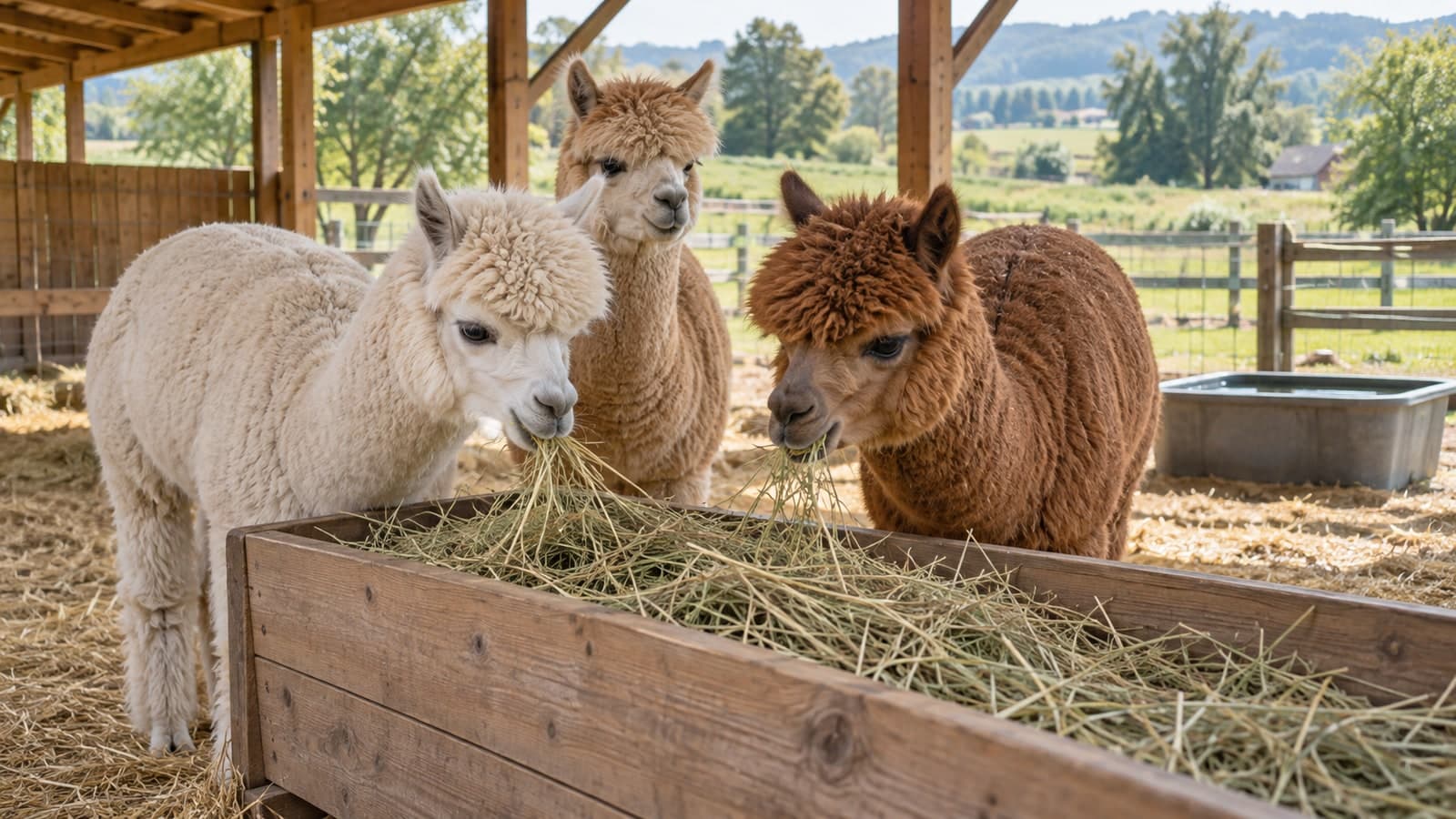
For most of the year, feeding an alpaca is refreshingly simple: good grass, good hay, clean water and a small handful of minerals made for camelids. Get those four things right and most healthy adults need little else; body condition tells you when the ration needs a tweak.
The detail changes with the season, the life stage and the pasture. This alpaca feeding guide walks you through what alpacas eat day to day, how much hay one adult needs, when a concentrate is worth adding, and the garden plants that can quietly kill a herd. Pair it with the Body Condition Score guide for the how-to-read-the-animal side, and our complete alpaca care guide for the wider husbandry picture. It is general guidance, not veterinary advice, so plan any change for a thin, sick, pregnant or growing animal with your vet.
Hay and Pasture Come First, Most of the Year
The foundation of an alpaca diet is grass hay and pasture, plus constant access to clean water. South American camelids are good at using plain forage; the International Llama Association's feeding brochure describes them as more efficient than sheep or cattle. Extra concentrates should meet a specific need rather than become the default.
A healthy adult eats roughly 1.5 to 2 percent of its body weight per day in dry matter. Dry matter means feed weight after the water is removed, which lets you compare feeds consistently. The Merck Veterinary Manual puts most camelids at 1.8 to 2 percent, and Rutgers Cooperative Extension gives the same band. Penn State's Robert Van Saun, pooling eight published intake studies, found a measured average closer to 1.5 percent. Together, those sources support the practical range above for an ordinary adult.
What hay to buy
Aim for a grass hay in the 10 to 14 percent crude protein range, with total digestible nutrients (TDN, a measure of how much of the hay is actually usable energy) of about 50 to 55 percent. That is the Merck Veterinary Manual's figure for the hay on which most adult alpacas and llamas hold their condition. In plainer language: clean, leafy grass hay that smells sweet. Never feed mouldy or dusty hay. If you want to know what is really in your hay, a forage analysis is cheap and tells you the protein and energy figures directly.
Alfalfa (lucerne) is richer in protein and calcium than grass hay. The International Llama Association's feeding brochure suggests keeping alfalfa to no more than one third of the total forage for adults. The Merck manual adds that legumes are usually not needed and may contribute to obesity.
Fibre matters as well. The ILA brochure suggests the total diet should be around 25 percent crude fibre or more to keep the fermentation stomach working properly. Long-stem hay, not a bag of pellets, is what supplies it.
One note on that brochure: it was written mainly about llamas, and says most of it applies to alpacas too. We use it here for proportions and percentages, which carry over, and we flag it where it gives an amount per animal, which does not.
Protein at a glance
You will see two kinds of protein number, and they are easy to mix up. Merck's 10 to 14 percent is a description of the hay that keeps most adults in good condition. The figures below are whole-diet targets by life stage from Rutgers Extension and the ILA brochure. They are not in conflict: a maintenance adult needs less than a decent grass hay usually supplies.
How Much Hay Does an Alpaca Eat?
For a 70 kg adult alpaca at 1.5 to 2 percent of body weight per day, the daily intake works out at about 1.05 to 1.4 kg of dry matter (70 × 0.015 = 1.05, and 70 × 0.02 = 1.4). Hay still holds a little moisture, so the weight you actually fork out is somewhat higher than the dry-matter figure.
That sits close to Rutgers Extension's figure for camelids kept on a dry lot with no grazing: about 1.4 to 2.3 kg of hay a day. Their range runs higher because it covers llamas as well as alpacas, and Rutgers notes that amounts differ between the two because of body weight.
Two footnotes. First, the how much changes with body weight, so a 50 kg maiden female and a 90 kg herdsire are not on the same ration. Second, the numbers above assume a mostly hay diet: when pasture is growing well, the herd grazes the equivalent and leaves the hay ring alone.
For pasture size and stocking density, see How to Start an Alpaca Farm, which covers how many alpacas a hectare can carry.
Water: More Than Most People Offer
Give free-choice fresh water year-round. Two sources give slightly different numbers, and we print both: the International Llama Association's feeding brochure puts daily intake at 5 to 8 percent of body weight depending on activity, temperature and whether the feed is green pasture or dry hay. For a 70 kg alpaca that is 3.5 to 5.6 litres. Rutgers Extension gives roughly 9 litres per 100 kg of body weight, which works out at about 6 litres for the same 70 kg animal. Plan for the higher figure and you will not run short.
The ILA brochure adds a practical point: camelids may be reluctant to drink from dirty containers, automatic drinkers included. Keep troughs clean, and in winter keep them ice-free.
Minerals: The Copper Warning Comes First
Pasture and hay do not always supply everything a camelid needs. Selenium and zinc depend on your soil, and vitamin D depends on winter sun, so the usual fix is a camelid-specific loose mineral offered free-choice. The "camelid-specific" part matters more than it sounds.
Choose a mineral for camelids with your vet, rather than substituting a cattle, goat or horse product yourself. The Merck Veterinary Manual warns that formulation errors and overlapping supplements can push total copper intake too high. Camelids do need some copper; the risk depends on the whole diet, not just the species printed on the bag. Check the mineral against your forage analysis and do not add other supplements without your vet reviewing the combined intake.
The calcium-to-phosphorus balance in the whole diet should sit at roughly 1.2 to 2.0 : 1 according to the ILA brochure. Too much alfalfa alongside a mineral high in calcium can push it out of that band, with growing crias especially vulnerable to an imbalance (more on that below).
The ionophore warning
One feed-store mistake can kill. Cattle feed additives called ionophores, such as monensin and salinomycin, are highly toxic to camelids. Merck names both, notes that they are found in many cattle feeds, and says pelleted or mixed grain feed intended for ruminants should not be fed to camelids, or even made in a facility that handles ionophores, because of the risk of accidental contamination. If you keep cows or share a feed store with a beef farm, keep alpaca and cattle feed apart, read the label on every bag, and never scoop from a bin you have not personally filled.
For the specific mineral doses your soil actually calls for, ask your vet. Regional deficiencies are real, and a proper mineral plan is a vet-and-forage-analysis question, not a blog answer.
When to Add a Concentrate
A healthy adult on decent hay does not need grain. Concentrates come out for four reasons:
- A thin animal (BCS 2 or below), where the target is gradual weight gain. Work through the Body Condition Score guide for the actual plan.
- The last two and a half to three months of pregnancy. Energy demand rises fast in that window.
- Lactation, especially the first three months.
- Prolonged cold weather, when a lot of feed energy goes into simply staying warm.
The usual concentrates for alpacas are oats, lupins and alfalfa. How much? Less than most people expect. The ILA brochure, written by veterinarian L. W. Johnson, caps cereal grain (oats, corn and the like) at about 450 g per day for a llama in two situations. In the last two and a half to three months of pregnancy it is introduced gradually, with a matching cut in forage. In truly cold weather (below freezing) the brochure's first step is simply free-choice forage, and grain comes on top of that only in an unusual case; the forage is not cut. A llama is a much bigger animal than an alpaca, so treat that as an upper bound you stay well under, and agree the actual amount with your vet.
Grain-heavy diets fatten alpacas quickly, and an obese alpaca is a welfare problem in its own right.
Feeding Pregnant and Lactating Females
For most of pregnancy, a healthy female stays on the same hay-and-mineral routine as the rest of the herd. Do not let her get fat along the way: the ILA brochure notes that over-fed animals often have more problems with conception, delivery and lactation. And never crash-diet a fat female to fix it, for the reason covered in the BCS guide.
In the last two and a half to three months of pregnancy and through lactation, aim for a slightly richer ration: the higher protein band in the table above, a modest concentrate if she is not holding her body condition, and free-choice mineral. The ILA brochure keeps that level going for the first three months of lactation, then tapers it down towards weaning. Making milk is hard work, so this is the one time of year to watch a female's condition closely.
Feeding Crias
The first 24 hours of a cria's life is a subject of its own: colostrum, timing and warmth all matter more than the hay does. Start with Newborn Cria Emergencies, then move on to the Cria Growth Curve for the daily-gain and birth-weight numbers.
Once solid feeding is established, the ILA brochure recommends a 16 percent crude protein creep ration for early-weaned crias, tapered down to 12 percent by six months. One warning specific to growing bones: the same brochure cautions that crooked legs can result when too much calcium in the diet, especially from alfalfa hay, leaves a youngster short of phosphorus. A free-choice mineral that contains phosphorus matters most during this fast-growing stage.
A Word on Vitamin D
Merck notes that seasonal vitamin D deficiency can be a problem in heavily fibred animals kept where winter sun is poor, which describes most of northern and central Europe. Growing crias are the ones to watch. Any vitamin D dosing (paste, injection or otherwise) is a vet decision, and the units on the label matter: a published German case series describes crias that died after a vitamin D overdose caused by confusing micrograms with international units. Do not dose from an article, including this one.
The Overweight Alpaca
An obese alpaca (BCS 5) needs slow, planned weight loss rather than a crash diet. Severe feed restriction can cause life-threatening hepatic lipidosis in camelids. Work with your vet on the cause and the feeding plan; the BCS guide explains what to monitor.
Plants That Can Kill an Alpaca
Alpacas are curious browsers, and a hedge on the far side of the fence or a pile of clippings tipped into the paddock is an easy way for them to meet a plant they should never eat. The Rocky Mountain Llama and Alpaca Association's toxic-plants list, drawn from Colorado State University's Guide to Poisonous Plants, names dozens of species.
The list is North American, but many of its names are just as familiar in European gardens:
- Trees: oak, horse chestnut, black walnut, red maple, black locust.
- Shrubs and hedges: yew, oleander, rhododendron and azalea, laurel, Japanese pieris (Pieris japonica), boxwood, privet, hydrangea, lantana.
- Flowers and vines: foxglove, larkspur, monkshood, castor bean, angel's trumpet.
Start with yew and oleander, simply because they are so common here: yew in hedges and churchyards across the UK and the German-speaking countries, oleander in Italian and other Mediterranean gardens. We have not found a vet-school source that ranks these plants by danger for alpacas, so treat every name on the list as one to keep out of reach, and ask your vet which local plants to add.
The practical rule is simple: walk your fence lines, know what is on the neighbour's side, and never toss hedge clippings into a paddock. If you are not sure what a plant is, ask before you plant it.
Parasite pressure on pasture is a separate topic with its own protocol: see The Data-Driven Alpaca Deworming Schedule.
Track What They Eat, Track How They Feel
Feeding rules are simple in theory and easy to lose track of in practice. A cold snap, a new bag of hay, a late-pregnancy dam whose ration went up and never came back down: these drift into problems before the herd starts to look thin or fat.
The habit that catches all of them is the one the BCS guide recommends: hands on every animal, once a month, along the spine. Pair that with a monthly weigh-in on a livestock scale and you can see a change coming.
This is why we built AlpacaKeep: a farm management tool that logs weights, body condition scores and health events over time, so you can see each animal's trend rather than guess.
Signups are not open yet. Join the early-access list and we will let you know the day you can move in. In the meantime, our free record-keeping templates are yours to download.
Sources & Further Reading
- Merck Veterinary Manual. Management of Llamas and Alpacas. Feeding basics, hay-grade targets, ionophore toxicity, copper caution.
- Van Saun, R. J. Update on Camelid Nutrition. Penn State University, hosted by the Oregon Veterinary Medical Association. PDF. Meta-analysis of measured intake, milk-energy revision, NRC-based protein targets.
- Johnson, L. W. Feeding Camelids. International Llama Association Educational Brochure #6 (1986, updated 1992). PDF. Written mainly about llamas. Protein bands by life stage, alfalfa share, crude fibre, cereal-grain ceiling, Ca:P ratio, water, early-weaning ration.
- Wagener, M. G. et al. (2021). Calcinosis in Alpaca Crias (Vicugna pacos) Due to Vitamin D Intoxication. Animals 11(8):2332. Full text. The unit mix-up behind the vitamin D warning.
- Westendorf, M. Llama and Alpaca Production: Nutrient Requirements. Rutgers Cooperative Extension. Rutgers Plant & Pest Advisory. Daily hay in a dry-lot, water intake, protein by life stage.
- Rocky Mountain Llama and Alpaca Association. Plants Poisonous to Alpacas and Llamas, attributed to the Colorado State University Guide to Poisonous Plants (2019).