 AlpacaKeep
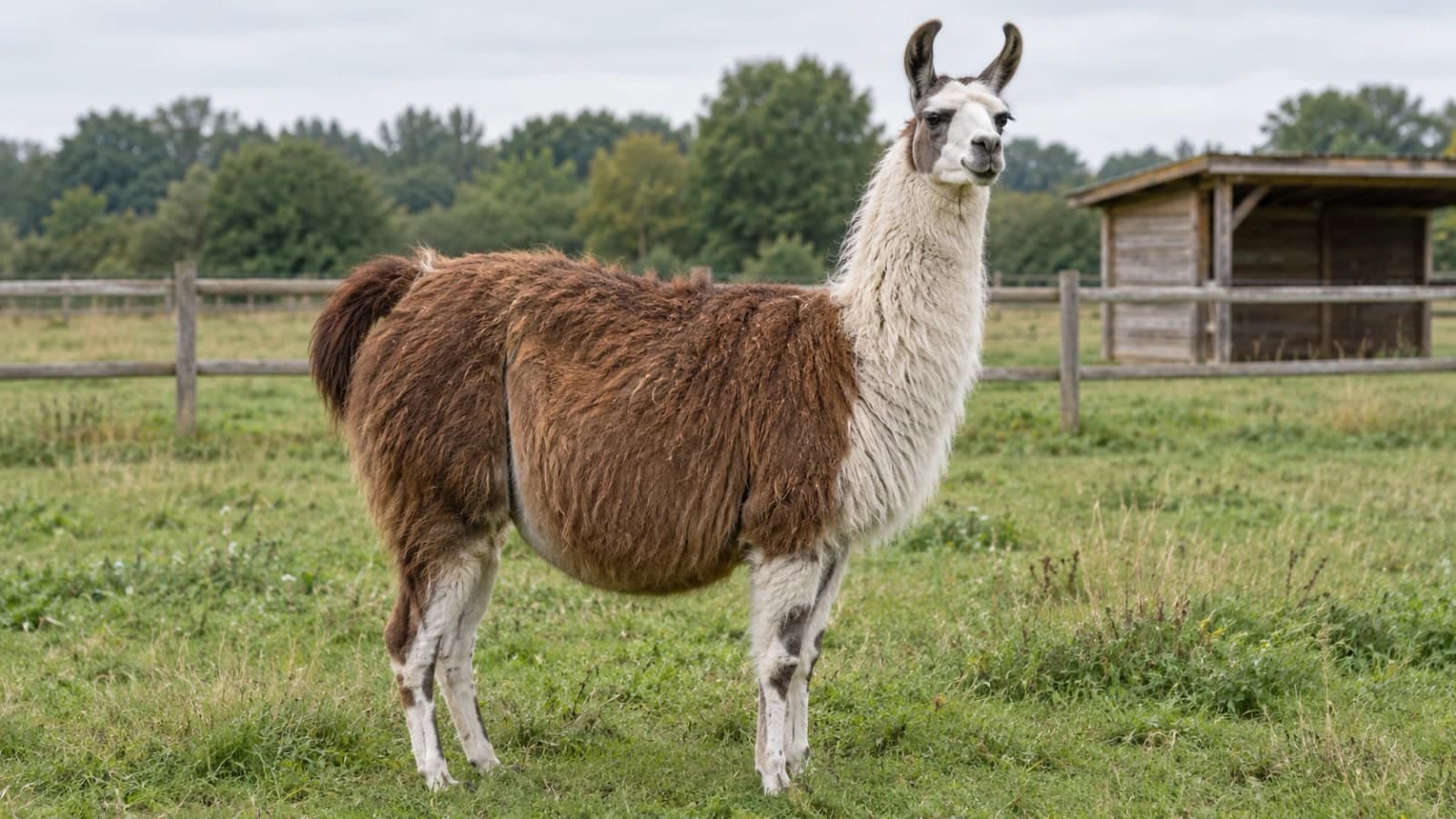
How long are llamas pregnant? Llama pregnancies usually last about 11 and a half months: roughly 345 to 350 days, with healthy births spread over several weeks either side, so a due date is best read as the middle of that range rather than a fixed day.
If you only need the due date, put her mating date into our gestation calculator (it has a llama setting). This guide covers why dates vary, how to confirm she is pregnant, and when to call the vet.
How long are llamas pregnant, according to the studies?
Only a few studies have measured it, and they differ a little.
A camelid textbook gives 342 to 360 days for llamas. A breeder survey in Austria, Germany and Switzerland, covering llamas and alpacas, found 88% of births between 335 and 360 days after mating.
For alpacas the picture is similar, with averages a few days shorter; our alpaca gestation guide covers them.
In practice: published averages sit between about 345 and 350 days; single healthy births have ranged from 327 days to over a year.
Why do llama due dates vary so much?
No study we found explains why. The averages in the two llama studies differ by about five days. Altitude, management, season and sample size could all play a part, but none has been shown in llamas. In alpacas, pregnancies from spring matings lasted about 12.5 days longer than those from autumn matings; we found no study that has looked at this in llamas.
There is no agreed "overdue" day for llamas. Write down the mating date, and give your vet's assessment of her more weight than the calendar.
Where llama checks differ: scans, palpation and cria weight
Llamas and alpacas carry for a similar time (the wider comparison is in alpaca vs llama). The differences are mainly in the pregnancy checks and in the cria:
- Scans work a little later. A scan through the rectum becomes reliable from about 34 days in llamas, against 23 days in alpacas.
- Palpation is an option. Llamas are large enough for your vet to feel the pregnancy by hand from about 45 days.
- Crias are heavier. Llama crias weigh about 9.9 kg at birth from maiden females and 11.8 kg from adults, so alpaca birth-weight rules of thumb do not apply.
How to tell if a llama is pregnant
Little shows on the outside for months, so breeders rely on behaviour, a scan or a blood test. Many combine them.
The spit-off check
From about two weeks after mating, the male is brought back to her. If she spits, runs off or refuses to sit, that suggests she is pregnant. A check in the first week tells you very little: at that stage a refusal mostly shows she has ovulated.
A refusal is a good sign, not proof. Between 15 and 30% of refusals turn out to be wrong, because of early loss, an abortion nobody noticed, or a female who is simply not interested. Write the result down and book a scan. Our breeding guide covers mating and the spit-off routine itself.
Ultrasound and palpation
- By hand: your vet can feel a pregnancy from about 45 days.
- Rectal scan: reliable from about 34 days in llamas.
- Belly scan: about 45 to 60 days.
A camelid textbook puts scan accuracy in llamas at 100% by day 75. Early losses are most common in the first two months, and a US camelid vet notes some embryo loss in llamas up to about day 65, so ask your vet whether a second check later on makes sense.
Blood tests
A progesterone blood test shows whether she has a working corpus luteum: the hormone-making tissue left on the ovary after ovulation.
- It supports a pregnancy but does not prove an embryo is there. A corpus luteum that stays on without a pregnancy is the usual false positive.
- Keep her away from the male before the sample, and let your vet and the lab read the result, because cut-offs differ between labs.
- Skip the cattle pregnancy blood test (it does not work in llamas) and dung hormone tests (not reliable yet).
Whether a reliable on-farm progesterone kit exists for llamas is a question for your vet.
The stages of a llama pregnancy
These are the stages as a keeper sees them, not a fixed calendar; each female moves through them at her own pace.
- The first two weeks. She ovulates after mating and progesterone climbs. There is nothing to see.
- From about two weeks. Refusing the male suggests she is pregnant. Note it and plan a scan.
- The first two months. This is when scans are done, and when early losses are most common.
- Mid-pregnancy. Months of little visible change. The aim is to keep her calm: avoid unnecessary handling, transport and changes to the herd.
- The last weeks. Progesterone starts to fall about two weeks before birth, and the udder and vulva changes described below follow. The outward signs vary.
Feeding stays as normal until the last two and a half to three months; the ration changes then are in what alpacas eat.
What can go wrong, and when to call the vet
Stress, heat and a prolonged fever can lead to the loss of a pregnancy. Her pregnancy relies on the corpus luteum from start to finish, which makes it sensitive to these and to some medicines, especially late on. Keep transport, rough handling and changes to the herd to a minimum, and tell any vet treating her that she is pregnant.
Many breeders plan matings so births avoid the hottest and coldest months; for heat in late pregnancy, see when to shear.
Common infectious causes of abortion include leptospirosis, toxoplasmosis and chlamydiosis; low selenium, vitamin A or iodine at herd level can also play a part. Often no cause is found. Ask your vet about herd mineral levels.
If she aborts:
- Call your vet straight away.
- Keep the fetus and the placenta, chilled, for the lab.
- Wear gloves when you handle them: some causes of camelid abortion can also infect people.
Also call the vet if she looks colicky in the last month without being in labour (a twisted uterus is one possibility; the birthing guide explains it), has a discharge, or goes off her feed.
The last weeks: what to watch and prepare
No single sign predicts the exact day, and a female may show these in any order, or not at all:
- The udder may fill two to three weeks before the birth in an experienced female, or not until a few days after the birth in a maiden.
- About a week before, some females show belly swelling, puffy teats or wax on the teat ends.
- The vulva relaxes and softens; in llamas this may be the only sign you get.
- On the day, she may wander off on her own, pass urine and dung more often and lose interest in food.
From there, the stages of labour and the moments to call the vet are in our birthing guide, and the first days of the cria's life in newborn cria emergencies.
Before she gets there:
- Have your vet's number to hand, and agree in advance what they want to hear about.
- Ask your vet about vaccine timing during pregnancy; our vaccination guide covers the alpaca schedule.
- Never try to bring on labour yourself. Drug induction is dangerous in camelids and is a vet's decision alone.
Keeping track of a llama pregnancy
The checks above are most useful when you can find them again later: the mating date, each spit-off result, the scan date and the vet's findings. For what else belongs in a llama's file, see llama and camelid records.
AlpacaKeep keeps each mating, spit-off check and scan together, counts her gestation day using the llama gestation length, and puts her on your dashboard's list of births to watch as her date approaches.
AlpacaKeep is built and run on a working alpaca farm and is in private beta now for farms in the EU, the UK, Australia and New Zealand, with every feature free for the beta farms. The Free plan for up to 10 animals stays free afterwards. Get early access.
Sources and further reading
- Leon JB, Smith BB, Timm KI, LeCren G. Endocrine changes during pregnancy, parturition and the early post-partum period in the llama (Lama glama). J Reprod Fertil 1990;88(2):503-511. Gestation length in 14 llamas, progesterone and oestrogen through pregnancy.
- Condorena N, Sumar J, Alarcón V. Período de gestación en llama (Lama glama). Turrialba 1992;42(1):112-113. Gestation length, cria sex and birth weight in Andean llamas.
- Tibary A, Anouassi A. Theriogenology in Camelidae, chapters on parturition, sexual behaviour, ultrasonography and hormone assays (IVIS). Gestation ranges, spit-off false positives, scan accuracy, signs before birth.
- Merck Veterinary Manual: Reproduction of Llamas and Alpacas. Gestation, the spit-off check, palpation and scan timing, progesterone, twins, induction.
- Merck Veterinary Manual: Abortion in Camelids. Infectious and nutritional causes, heat stress.
- Johnson LW. Current Concepts in Camelid Reproduction. Society for Theriogenology, 2002. Long and premature pregnancies, stress and pregnancy loss, embryo loss in llamas.
- Parraguez VH et al. Early pregnancy diagnosis in alpaca (Lama pacos) and llama (Lama glama) by ultrasound. Anim Reprod Sci 1997;47(1-2):113-121.
- Bravo PW, Stewart DR, Lasley BL, Fowler ME. Hormonal indicators of pregnancy in llamas and alpacas. JAVMA 1996;208(12):2027-2030.
- Wolfthaler J et al. A survey among breeders of South American camelids concerning breeding and reproduction management. Tierärztl Prax Ausg G 2020;48(6):386-397.
- Rüfli I et al. Causes of Abortions in South American Camelids in Switzerland: Cases and Questionnaire. Animals 2021;11(7):1956.
- Wittek T et al. Could fecal estrone sulfate be used as a confirmatory pregnancy diagnosis in South American camelids? Tierärztl Prax Ausg G 2025;53(4):226-230.
- Drew ML, Alexander BM, Sasser RG. Pregnancy determination by use of pregnancy-specific protein B radioimmunoassay in llamas. JAVMA 1995;207(2):217-219.
- Davis GH, Dodds KG, Moore GH, Bruce GD. Seasonal effects on gestation length and birth weight in alpacas. Anim Reprod Sci 1997;46(3-4):297-303.
- Ponthier J et al. Pregnancy Length, Offspring Weight and Birth Outcomes in Alpaca (Vicugna pacos): An International Survey. Reprod Domest Anim 2025;60(10):e70130.