 AlpacaKeep
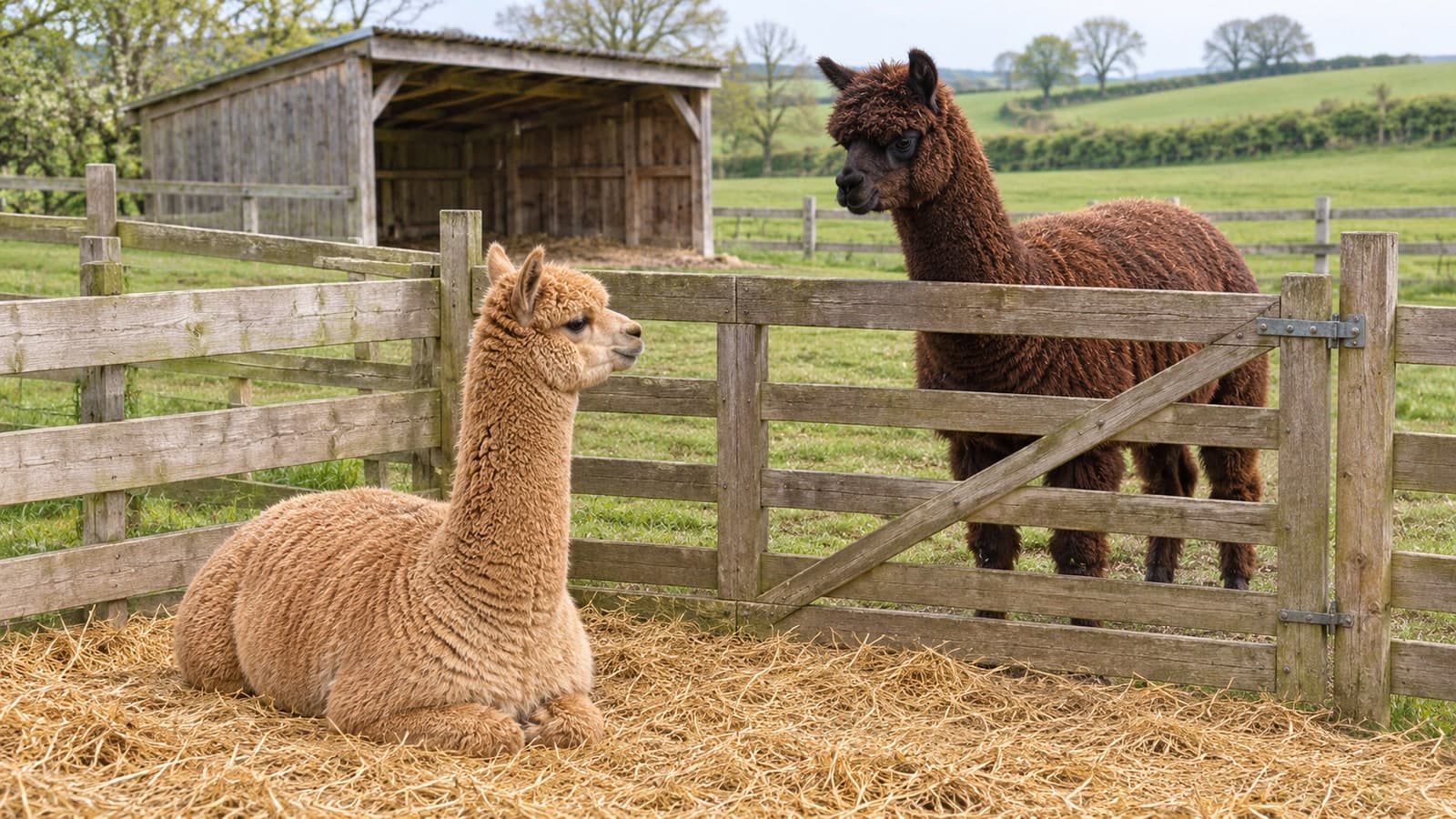
Alpaca mating works differently from most livestock: the female has no regular heat cycle, and the mating itself is what makes her release an egg. She sits down in the cush position, the male mounts her from behind and makes a guttural orgling sound, and a mating usually lasts about 15 to 20 minutes.
If you are planning matings, the wider picture, from choosing animals to weaning, is in our alpaca breeding guide.
How alpaca mating works
The mating triggers ovulation
Alpaca females are induced ovulators: the mating itself sets off the release of an egg, a little over a day later (24 to 30 hours, says the Merck Veterinary Manual).
A mating does not always work. A camelid reproduction textbook says ovulation fails after a mating in up to 30% of cases, so a single mating is a start, not a result.
Can alpacas be mated all year?
Yes. The Australian Alpaca Association calls alpacas non-seasonal breeders, and the Merck Veterinary Manual says camelids living outside their natural range may breed year-round. What matters is when the cria arrives: the Australian Alpaca Association and a US camelid vet both advise timing matings so births avoid the extremes of heat and cold.
How long does alpaca mating take?
Most sources put a mating at about 15 to 20 minutes, and anything from about 5 minutes up to 45, 50 or 55 minutes happens, depending on the source. Length does not tell you whether it worked: it made no difference to pregnancy in one Australian study of 70 matings, or to ovulation in a Peruvian study.
A mount is not always a mating. A male can go through all the motions without actually entering the female (camelid textbook), so with an inexperienced male, see for yourself that he did (Merck Veterinary Manual).
Is the female ready to mate?
Size matters more than age. Most sources put a female's first mating at about 60% of adult weight, or about 40 kg, and they differ on age from about 14 months to about 24 months.
Sexual maturity comes earlier (about 12 to 15 months and 45 to 50 kg, says the Australian Alpaca Association's sheet), but maturity is not the age for a first mating. Waiting protects her: the Merck Veterinary Manual names the risk of a difficult birth in small young females, and the camelid textbook says breeding young or underdeveloped females usually leads to more early embryo loss, abortion or trouble at the birth.
A female that sits is not necessarily ready. The camelid textbook says early receptivity is a poor guide, and sitting can simply be a submissive gesture from a low-ranking female. Weigh her rather than trusting her behaviour.
Is the male ready to mate?
Sources put the age a male can mate fully between about 18 months and 3 years. His penis is attached to its sheath at first and comes free gradually: in 70% of males by 2 years and in all by 3, says the camelid textbook, which recommends 3 for breeding. The Merck Veterinary Manual sits at the early end (most males start at 18 to 24 months), while the Australian Alpaca Association and the UK government guidance say about 2.5 to 3 years.
Young males can surprise you. Some can breed from about nine months (British Alpaca Society), and the UK government guidance warns that younger males may be able to get a female pregnant. None of the sources we read gives a fixed age for moving young males away from the females.
Supervised mating or paddock mating?
In supervised mating (also called hand or pen mating) you bring one female to the male and watch. In paddock mating the male runs with a group of females, in the Australian Alpaca Association's words "for several weeks". The same association notes that supervised mating takes more of your time.
The camelid textbook credits supervised mating with better stud management, fewer accidents, precise records and close supervision. The New Zealand study is one small trial, not proof that one method works better.
How hard can one male work?
No study has settled how many females one male should serve, says the camelid textbook, but a few studies show where the limits start:
- Two or four matings a day held up. In a Peruvian study of 280 females over 9 days, fertility was 76% when males mated two or four times a day and 59% at six.
- Daily use runs him short. In a Chilean study, males mating every day for five days could cover without enough sperm by the end, and only partly recovered after a rest.
- A second cover adds little. The camelid textbook says a second mating 6 or 24 hours after the first sets off no second ovulation signal, and in the Australian study one or two matings made no difference.
Heat matters too. The Merck Veterinary Manual says heat stress can reduce a male's fertility for several weeks or permanently; a US camelid vet calls it usually temporary. See alpacas in hot weather.
The spit-off test: what a refusal tells you
A refusal is a good sign, not proof. After a mating, breeders bring the male back to the female: if she spits, runs off or refuses to sit, that suggests she ovulated and may be pregnant. If she sits for him, she is probably not pregnant.
When you test changes what a refusal means. The Australian Alpaca Association's sheet says a refusal at 7 days shows she has ovulated, and one at 14 days or more means pregnancy "is likely"; the Merck Veterinary Manual reads a refusal more than 15 days after the mating as a sign of pregnancy. Our gestation calculator lays these checks out on a timeline from her mating date.
Why a refusal is a sign, not proof
The UK government guidance calls the spit-off "the most supportive indicator of early pregnancy", and it is still not a confirmation:
- Some refusals are wrong. The camelid textbook expects 15 to 30% of refusals to come from females that are not pregnant (early embryo loss, an unnoticed abortion, or individual behaviour).
- A sit can mislead too. The same textbook notes that some alpaca females allow mating while pregnant.
- Unmated females have off days of one to two days when they refuse the male (a British Alpaca Society fact sheet; the textbook says about 48 hours).
- The advice sheets say so themselves. The Australian Alpaca Association's sheet (and the British fact sheet that shares its wording) states that the first refusal "is not a confirmation of pregnancy".
The same two sheets recommend bringing her to a male "e.g. six weekly" through the pregnancy, because embryos can still be lost.
Confirming with a scan
Only a scan confirms. Depending on the scanner, a pregnancy can show from around day 30, and the usual routine check is after about day 60 (British Alpaca Society). The UK government guidance calls a scan through the belly effective from about day 45.
More on confirming a pregnancy is in our llama gestation guide, and on the alpaca pregnancy itself in the alpaca gestation guide.
When to try again
A sit at a later check is the usual sign that she needs another mating, not a reason to worry. The camelid textbook expects a female that did not conceive to come back into receptivity 12 to 18 days after the mating, and up to 30% of matings fail to trigger ovulation at all. In supervised mating, leave at least 7 days between attempts (a US camelid vet).
When to look closer
A female still not pregnant after two matings counts as a repeat breeder worth examining, maiden or not, says the camelid textbook. Its causes are failure to conceive and early embryo loss, and the management errors it lists include using a young male, overusing a male, and not checking that the male actually entered her.
How often a single mating works varies by source: the Australian Alpaca Association's sheet calls 75 to 80% "not uncommon", while 49% of the 70 matings in one Australian study led to a pregnancy. In a Peruvian study of 167 females, females already mated before without success lost the embryo in the first 45 days more often (almost half of them) than maidens or females nursing a cria (under a third). The Merck Veterinary Manual, on the other hand, says nursing and very young maiden females can have more losses.
Mating again after a birth
Sources put the first re-mating somewhere between about 10 days and three weeks after the birth. The British Alpaca Society says she should be fit to return to a male from 10 to 14 days, the Merck Veterinary Manual says most females can conceive within 14 to 21 days, and the Australian Alpaca Association's birthing sheet says to wait until 15 to 20 days, adding that a female occasionally refuses for up to 40 days.
The gestation calculator includes the re-mating window after a birth, and the birth itself is in our birthing guide.
Choosing the male and keeping the record
Which male to use is a separate question: inbreeding is covered in our pedigree guide and risky colour pairings in coat genetics and lethal crosses.
Besides the date, note whether the mating was supervised or in the paddock, how many covers you saw, who watched, and each spit-off result; the full list is in how to keep alpaca records.
AlpacaKeep records each mating with its sire, date and method (natural or artificial insemination), and keeps every spit-off test and scan on that mating without ever telling you when to test or deciding a pregnancy for you. Its mating recommender ranks possible mates from your own herd.
AlpacaKeep is built and run on a working alpaca farm and is in private beta now for farms in the EU, the UK, Switzerland, the US, Australia and New Zealand, with every feature free for the beta farms. The Free plan for up to 10 animals stays free afterwards. Get early access.
Sources and further reading
- Australian Alpaca Association. Alpaca Advice: Reproduction and Mating (advice sheet). Induced ovulation, cush, mating length, supervised and paddock mating, spit-off at 7 and 14 days, maturity.
- Australian Alpaca Association. Alpaca Advice: Alpaca Birthing and Cria Care (advice sheet). Re-mating after a birth.
- British Alpaca Society. Alpaca Fact Sheet #1: Alpaca Reproduction and Fact Sheet #2: Alpaca Mating Behaviour (reviewed 2018, adapted from Bourke 1998). Mating length, spit-off, scan timing.
- British Alpaca Society. Care and Welfare: Reproduction (web page). Female and male readiness, re-mating after a birth.
- Animal and Plant Health Agency (UK). South American camelids (guidance, 2025). Maturity, first mating, spit-off, scans.
- Merck Veterinary Manual: Reproduction of Llamas and Alpacas; Abortion in Camelids.
- Tibary A, Anouassi A. Theriogenology in Camelidae, chapters on puberty, mating behaviour, the oestrous cycle, the postpartum period, infertility and herd management (IVIS).
- Johnson LW. Current Concepts in Camelid Reproduction. Society for Theriogenology, 2002.
- Pollard JC, Moore GH, Littlejohn RP. The sexual behaviour of alpacas imported to New Zealand from Chile. Proc N Z Soc Anim Prod 1991;51:43-46.
- Vaughan JL, Macmillan KL, Anderson GA, D'Occhio MJ. Effects of mating behaviour and the ovarian follicular state of female alpacas on conception. Aust Vet J 2003;81(1-2):86-90.
- Brown BW. A review on reproduction in South American camelids. Anim Reprod Sci 2000;58(3-4):169-195.
- Bravo PW, Solis P, Ordoñez C, Alarcon V. Fertility of the male alpaca: effect of daily consecutive breeding. Anim Reprod Sci 1997;46(3-4):305-312.
- Urquieta B et al. Alpaca semen characteristics under free and directed mounts during a mating period. Anim Reprod Sci 2005;90(3-4):329-339.
- Bravo PW, Diaz D, Alarcón V, Ordoñez C. Effect of the reproductive state of female alpacas on embryonic mortality rate. Am J Vet Res 2010;71(9):1096-1099.